Walking Through Osaka Aquarium Kaiyukan: Whale Sharks, Giant Tanks & an 8-Floor Spiral Descent Into the Pacific

Contents
Walking Through Osaka Aquarium Kaiyukan

Osaka Aquarium Kaiyukan stands next to Tempozan Marketplace and ranks among the largest aquariums in Japan.
Located near Yumeshima — the site of Expo 2025 Osaka — and in the same bay area as Universal Studios Japan (USJ), Kaiyukan is one of Osaka’s most popular attractions.
In this article, you will walk through Kaiyukan with me from arrival to exit. I cover all 14 main tanks plus the special exhibits, so you can get a real feel for what a visit is like.
If you want a quick overview of the highlights and key tips, check out the guide below.
Read more about highlights of Osaka Aquarium Kaiyukan
Arriving at Kaiyukan

Here we are at Kaiyukan!
Getting here is straightforward. From JR Osaka Station, take the Osaka Loop Line toward Nishikujo, transfer at Bentencho Station to the Osaka Metro Chuo Line (toward Yumeshima or Cosmosquare), and you will arrive at Osakako Station — the nearest station — in about 20 minutes.
From Osakako Station, Kaiyukan is about a 10-minute walk.
Ticket Counter & Entrance Gate

You need a ticket to enter Kaiyukan. You can either buy an e-ticket in advance or purchase one at the ticket counter on the day of your visit.
Kaiyukan is one of the top tourist spots in Osaka. Even on this weekday, the ticket counter was crowded with a long queue.

Depending on how busy it is, buying a ticket at the counter may not guarantee immediate entry, so I highly recommend purchasing an e-ticket beforehand.
Read more about e-tickets
Kaiyukan uses dynamic pricing, meaning admission fees vary by date. For information on discounts and ways to save, see the article below.
Read more about discount tickets
Since I had already purchased an e-ticket, I headed straight to the entrance gate without waiting in line.

From arrival to entry in just 5 minutes.

At the entrance, I got to snap a photo with a large whale shark monument that greets every visitor.

The Entrance Hall
As you step inside Kaiyukan, a huge display screen plays immersive footage that instantly builds excitement.

The entrance lobby has coin-operated lockers. Since this lobby connects to the exit as well, you can store your bags here before starting your tour and pick them up right before you leave — a great way to explore hands-free.

Kaiyukan is one of the largest aquariums in Japan, and the walking route is quite long. I recommend stowing any heavy or bulky bags in the lockers before you begin.

All right, let’s start the tour!

Aqua Gate

The tour begins at the Aqua Gate — a tunnel-shaped tank drenched in vivid blue. Colorful fish and rays glide overhead, and you instantly feel that rush of being inside an aquarium.


Straight Up to the 8th Floor! The 40-Meter Long Escalator
When you enter Kaiyukan, you start on the 3rd floor. From here, a single escalator carries you all the way up to the 8th floor. This escalator is incredibly long — 40 meters (about 131 feet) — and feels like a ride in itself. Kaiyukan’s layout is unique: after reaching the 8th floor, you gradually spiral down through the exhibits, observing the tanks at different depths as you descend.

Kaiyukan’s exhibits are themed around 14 seas along the Pacific Ring of Fire.
However, true to the aquarium’s concept — “Ring of Fire, Ring of Life” — the focus extends beyond ocean life to encompass the Earth itself and all the life and nature that call it home. This is what sets Kaiyukan apart from other aquariums.
If I had to sum up Kaiyukan’s appeal in one sentence:
“From land to the deep sea, enjoy the waters of the Pacific from around the world.”
As the escalator nears the top, the adventure is about to begin.

1. Japan Forest

The first of the 14 exhibits is Japan Forest. As the name suggests, it recreates the mountains and streams of the Japanese countryside.
Just look at all these trees — you might forget you are inside an aquarium! The level of detail in this recreation is stunning.

Of course, this is still an aquarium, so there is a stream teeming with freshwater fish.

The highlight of this area is that you can enjoy plants as much as the fish. Keep an eye out for seasonal flowers quietly blooming here and there.


From Forest to Sea

One fascinating feature of Kaiyukan is that exhibits span multiple floors. Japan Forest stretches across both the 8th and 7th floors — the 8th floor recreates the land, and as you descend to the 7th floor, you transition into the water. That is exactly what this section, From Forest to Sea, represents.

You can spot many kinds of fish here, but the star of this exhibit is the Asian small-clawed otter.

Two of them were playfully wrestling, and the crowd around them never thinned out — utterly adorable!

2. Aleutian Islands
As you continue along the route, the next exhibit is the Aleutian Islands, recreating the ecosystem of these islands floating in the cold North Pacific.

Here you will find tufted puffins — seabirds that are absolutely adorable.

3. Monterey Bay
Next up is Monterey Bay, an area that recreates the rich coastline of Northern California.

In the Monterey Bay exhibit, you can watch California sea lions.

The sea lions dart around freely, so they never stay in one spot. When one zooms past the glass, cheers erupt from the crowd — it creates a wonderful sense of shared excitement.


4. Panama Bay

Panama Bay represents the warm seas of Central America, where you can get up close to vibrant tropical fish.
The soldierfish stand out with their brilliant red color — they truly pop against the blue water.

5. Ecuador Tropical Rainforest

The Ecuador Tropical Rainforest unfolds the world of South American freshwater fish surrounded by dense tropical greenery.


Plants grow along the water’s surface too. With so much greenery, you sense a mystique quite different from a colorful coral reef — a beautiful collaboration between plants and fish.

I did not manage to spot one this time, but the giant arapaima (pirarucu) also lives here, so keep your eyes peeled. The schools of angelfish are another highlight.
6. Antarctica

The Antarctica exhibit faithfully recreates the harsh cold of the polar region — a world of ice and snow.
Three species of penguin live here: Adelie penguins, king penguins, and gentoo penguins. They are utterly charming and adorable.

The moment I saw them, I decided I absolutely had to buy a penguin plushie at the gift shop.
Every little gesture captures your heart. Antarctica is one of my favorite areas, so make sure to take your time watching them.

7. Tasman Sea

The Tasman Sea exhibit recreates the waters stretching between Australia and New Zealand.
Here you can see Pacific white-sided dolphins.

Unfortunately, the dolphins were so fast I could barely capture them on camera!
The sheer speed at which they swim tells you just how enormous Kaiyukan’s tanks really are. Enjoy watching them zoom around with total freedom.

8. Great Barrier Reef
The Great Barrier Reef — the world’s largest coral reef, stretching off the northeast coast of Australia. This exhibit brilliantly recreates that underwater paradise.

As you would expect, the colors are absolutely stunning. This is the kind of underwater scenery you dream of experiencing at least once in your life — and it is beautifully reproduced right here.

The coral formations are artificial, yet their realism is remarkable. Is this really Osaka? That thought might cross your mind as you feel transported to the waters off Australia.

9. Pacific Ocean

The Pacific Ocean exhibit is arguably the climax of the entire Kaiyukan experience. This colossal tank — 9 meters (about 30 feet) deep and holding 5,400 tons (approximately 1.43 million gallons) of water — lets you watch a spectacular procession of marine life.


Crowd favorites like the ocean sunfish and rays are here.


The undisputed star of this giant tank is the whale shark. It is simply massive! Watching it swim with such majesty, you feel the sheer power of life and nature.


The Pacific Ocean tank spans floors 6 through 4, plus the 3rd floor. Each floor offers a different perspective and sense of scale, so be sure to stop and look at every level.

To see just how mesmerizing and calming this giant tank really is, check out the video below.
10. Seto Inland Sea

The Seto Inland Sea is known in Japan as a warm, calm body of water rich in nutrients that supports a diverse ecosystem. This exhibit showcases not only its marine life but also elements of “human connections with the sea” — octopus pots and glass fishing floats that represent the region’s fishing culture.


11. Special Exhibit Tank

This tank is a little different from the other exhibit areas. It features marine creatures that change with the Japanese seasons, available only for a limited time.
During my visit, I had the chance to see bigfin reef squid.

What creatures will you encounter when you visit? That is part of the fun — find out for yourself!

12. Chilean Rocky Shore

At the Chilean Rocky Shore, you can witness a massive school of sardines swirling through the tank. This is the famous “Sardine Meteor Shower” (Iwashi Ryuseigun) — Kaiyukan’s own name for the spectacle — and it is personally my top recommendation. Thousands of sardines swirl in unison, round and round.

The sheer sight of sardines filling your entire field of vision is truly breathtaking. Their scales catch the light and shimmer like shooting stars — it really lives up to the name “meteor shower.”

Be sure to enjoy it on video as well.
13. Cook Strait

Cook Strait recreates the fast-flowing waters of the strait separating New Zealand’s North and South Islands.
You will encounter colorful fish such as drummer and splendid alfonsino.

I did not spot one myself, but green sea turtles also live in this tank. If you are lucky, you might catch one sleeping wedged between the acrylic panel and a rock.
14. Japan Deep

The last of the 14 tanks is the Japan Deep, representing the Japan Trench — which reaches a maximum depth of 8 km (about 5 miles). This exhibit showcases creatures living at depths of around 200 meters (about 656 feet).


Even in the pitch-dark depths where no light reaches, this many creatures thrive. It is a humbling reminder of the resilience of life and the power of nature.
The Japanese giant spider crab here is impressively large.

All 14 Exhibits Complete — Time for a Cafe Break
After spiraling down from the 8th to the 4th floor, you have now seen all 14 exhibit areas. With that much to take in, your legs deserve a rest.
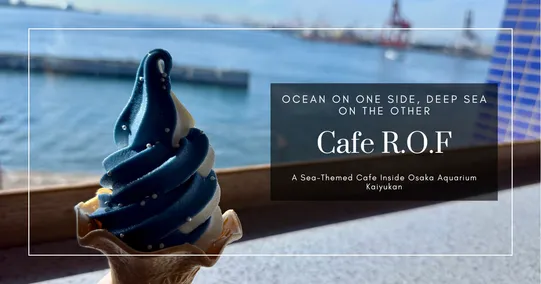
Conveniently located right after the last exhibit (Japan Deep) is cafe R.O.F.

The cafe offers great views and a creative menu. You can even enjoy your break while gazing at the Japan Deep tank — a perfect way to recharge. Make sure to stop by!
Read more about cafe R.O.F
Various Special Exhibits
So far, we have followed the permanent exhibits along the route, but Kaiyukan also features a range of special exhibits.
Gyugyutto Cute

Gyugyutto Cute is a special exhibit showcasing adorable sea creatures. The famous clownfish — known to many as Nemo — and spotted garden eels can both be found here.


Jellyfish Galaxy

Jellyfish Galaxy (Kurage Ginga) features ethereal jellyfish drifting through the water. In contrast to the colorful world of the previous exhibits, this space uses a monochrome palette to evoke the feel of outer space.


Arctic Zone
Although it does not sit along the Pacific Ring of Fire, Kaiyukan also has an exhibit dedicated to Arctic wildlife.
The star here is the ringed seal, beloved for its irresistibly cute face.

Inochi Guruguru Coral Exhibition

Inochi Guruguru Coral Exhibition is a special exhibit dedicated to coral and the circle of life. This was a real treat — the colorful corals and fish are delightful. You can feel the love and dedication of the Kaiyukan staff behind this exhibit. Note that this exhibition is scheduled to run until around autumn 2026.


Souvenirs at the Kaiyukan Official Shop
With every exhibit behind you, it is time for souvenirs.
Head to the official shop on the 3rd floor, which was freshly renovated in December 2025, and pick up some gifts to take home.

Here you will find plushies, bags, accessories, apparel, and much more.


So Much to See — One of Japan’s Largest Aquariums Delivers

And that brings us to the exit.
My total visit time came to 1 hour and 40 minutes.
If you skip optional experiences like the backyard tour, plan for about 2 hours and you should be comfortable.
Fourteen tanks, a variety of special exhibits.
Thrilling moments, beautiful scenery, and pure relaxation.
Beyond that, a consistent sense of the interconnectedness of life and nature throughout the entire visit.
“Ring of Fire, Ring of Life.”
“Everything is connected.”
The concept and the way the exhibits bring it to life are truly impressive.
The cafe offers a uniquely aquarium-themed space with creative menu items, and the gift shop is full of things you will want to take home.
Whether you love aquariums, are visiting as a couple, or are here with family — no matter who you are or who you are with, you are in for a wonderful time.
Make your way to Osaka Aquarium Kaiyukan at Tempozan. Combining it with a trip to USJ is also a great idea.
