Nishi Chaya District Guide: Kanazawa's Historic Street Lined with Latticed Teahouses

Contents
Latticed Streetscapes and a Living Teahouse Culture: The Highlights of Nishi Chaya District

Kanazawa is home to three teahouse districts (chaya-gai) that still carry on the teahouse culture that flourished in the castle town of Kaga: Higashi Chaya District, Kazuemachi, and Nishi Chaya District.
The most famous is Higashi Chaya District, which bustles with visitors. But Nishi Chaya District, just across the Saigawa River, has also flourished for around 200 years since the days of the Kaga castle town. It remains a geisha district where teahouse culture is still deeply alive.
Along its short street lined with teahouse buildings fronted by projecting wooden lattices (degōshi), you will find long-established shops serving Kaga sweets, Japanese-style cafes, and a number of renowned restaurants. With the sounds of shamisen and flute still drifting through the air, it is a living teahouse district.
This article introduces the charms of Nishi Chaya District.
Nishi Chaya District

Nishi Chaya District, in Nomachi, Kanazawa City, Ishikawa Prefecture, is one of Kanazawa’s three teahouse districts, alongside Higashi Chaya District and Kazuemachi. Located south of the Saigawa River, it is known for its streetscape of teahouse buildings lined with projecting wooden lattices.
| Item | Details |
|---|---|
| Name | Nishi Chaya District (Nishi Chayagai) |
| Hours | Varies by shop and facility |
| Location | Nomachi, Kanazawa City, Ishikawa 921 - 8031 |
| Access | About a 3 - minute walk from the "Hirokoji" bus stop on the Kanazawa Loop Bus / Hokutetsu Bus; about a 1 - minute walk from the "Nishi Chayagai" bus stop on the Kanazawa Flat Bus Nagamachi route; within walking distance of the Nagamachi Samurai District and Korinbo |
| Official Site | https://www.kanazawa-kankoukyoukai.or.jp/spot/detail_10199.html |
A Streetscape of Two-Story Teahouses and Stone Paving: A Teahouse Town Distilled into a Single Street
The greatest highlight of Nishi Chaya District is, above all, the streetscape itself.

Lining both sides of the street are two-story teahouse buildings. On the ground floor are projecting wooden lattices, with rows of fine, evenly spaced wooden slats. Above them, tall second floors holding banquet rooms stretch one after another along the street. Lantern-shaped street lamps stand along the way, and stone paving runs underfoot. The scenery of a teahouse town that blossomed in the Kaga castle town fits neatly into a single street.

Compared with Higashi Chaya District, the street in Nishi Chaya District is shorter and far quieter. That is precisely why you can savor the atmosphere of a Kaga teahouse town at a relaxed, unhurried pace.
In spring, the weeping cherry trees facing the street come into bloom. The scene woven by their pale pink blossoms and the wooden-latticed teahouse buildings is a springtime highlight unique to Nishi Chaya District.

After dark, Nishi Chaya District grows even more atmospheric. Lights glow behind the lattices and from the street lamps, softly illuminating the stone-paved street. At dusk, geisha on their way to banquets sometimes pass along the street.

Founded as a Domain-Sanctioned Teahouse Town Two Centuries Ago
Why has such a streetscape been preserved in Nishi Chaya District? Behind it lies two centuries of teahouse-town history.
In Kanazawa’s castle town, teahouses had long gathered around the great bridges spanning the Saigawa and Asanogawa rivers. The Kaga Domain officially sanctioned them in 1820 (Bunsei 3). Along with the “Higashi” (east) on the Asanogawa, a teahouse town was also established at the “Nishi” (west) across the Saigawa, and the two geisha districts adorned the entrances to the castle town.

The streetscape that continues today is also a form once lost and then regained. In the great fire of 1880 (Meiji 13), Nishi Chaya District burned to the ground. For the rebuilding, the form chosen was unchanged from the domain era. The teahouse design, with projecting wooden lattices of fine, even slats on the ground floor topped by a tall second floor housing banquet rooms, was carried on even after the great fire and survives to this day.
A “chaya” is, in essence, a place where geisha (geigi) entertain guests by displaying arts such as shamisen and dance. Geisha are still active in Nishi Chaya District, where their arts continue to be passed down.
The buildings that have long handled the geisha’s training and coordination are known as kenban. The kenban of Nishi Chaya District is the Nishi Kenban Office, a Western-style building constructed in the Taishō era (1912–1926). It stands out strikingly among the wooden teahouse buildings lining the street and is a nationally Registered Tangible Cultural Property. Even now, the sounds of geisha practice sometimes echo down the street.

One note: at teahouses and ryotei, geisha hospitality follows the “ichigensan okotowari” custom, accepting only guests introduced by an existing patron. Because they cannot be used without an introduction, the teahouses lining the street are, as a rule, admired from the outside as part of the townscape.

From Sweets Shops to Fine Dining: Tasting Your Way Through the Teahouse Town
Many of the teahouse buildings lining the street are still working shops today. A long-established rakugan (dry pressed sugar sweets) shop dating to the Edo period, Japanese cafes set in converted teahouses, restaurants serving Kaga ingredients, and wine bars. From sweets to meals to a single glass of sake, the flavors of Kaga are gathered along this one street.

| Shop | Genre | Hours | Closed | Notes |
|---|---|---|---|---|
| Rakugan Moroeya Nishi Chaya Karyo | Wagashi | Mar–Oct 10:00 am–6:00 pm / Nov–Feb weekdays 10:00 am–5:30 pm (cafe 10:00 am–5:00 pm) | Tuesdays (next day if a holiday) | A long - established rakugan shop founded in 1849 (Kaei 2). Seasonal fresh sweets and shaved ice are served at the cafe |
| Amanatto Kawamura | Wagashi | Weekdays 9:30 am–6:00 pm / Sun & holidays 9:00 am–5:00 pm | 1st Tuesday (open in Jan, May, Dec) | A specialty shop for amanatto (sugared beans) made without bleach, coloring, or preservatives |
| mame Nomanoma | Japanese sweets | Weekdays 9:30 am–5:00 pm / Sun & holidays 9:00 am–4:30 pm | 1st Tuesday (open in Jan, May, Dec) | A grab - and - go sweets shop run by Amanatto Kawamura |
| Salon de The Kawamura | Cafe | Weekdays 10:00 am–5:00 pm / Sun & holidays 10:00 am–4:00 pm | 1st Tuesday (open in Jan, May, Dec) | A tearoom on the second floor of Amanatto Kawamura, serving sweets such as warabi - mochi |
| Yusura | Cafe | 10:00 am–5:00 pm (evening reservation - only bar 6:00 pm–11:00 pm) | Wednesdays | A Japanese cafe in a converted teahouse, with teahouse katsu sandwiches and homemade sweets |
| CAFE Kawaii Koinu | Cafe | 10:00 am–5:00 pm | Wednesdays | A cafe on the first floor of the Dolls Museum, serving siphon - brewed coffee and cascara drinks |
| Oryori Maruyama | Japanese cuisine | 6:00 pm–10:00 pm (lunch kaiseki on weekends) | Mondays | A kappo restaurant run by a chef who honed his skills on Miyakojima |
| Washoku Dining Banrai | Japanese cuisine | Weekdays 11:00 am–2:30 pm / weekends 10:00 am–2:30 pm, dinner 5:30 pm–11:00 pm | Irregular | A Japanese dining spot for sushi and washoku made with local Kaga ingredients |
| Sanpi Ryoron Kanazawa | Japanese cuisine | Lunch 11:30 am–2:00 pm (Sat, Sun & Mon only) / dinner 5:30 pm–9:00 pm | Tuesdays & Wednesdays | The Kanazawa branch of Sanpi Ryoron, the popular restaurant by chef Masahiro Kasahara, serving Japanese cuisine that highlights local produce |
| BAR Nishi Kazutomi | Bar | 7:00 pm–11:00 pm | Sundays & holidays | A modern Japanese - style wine bar set in a converted old teahouse |
| Sugano | Bar | - | - | - |
| Dolls Museum | Museum | 10:00 am–5:00 pm | Wednesdays | Exhibits Japanese dolls. You can paint dolls and try on a kabuto jinbaori or iro - uchikake |
| Ninja Weapon Museum | Museum | 10:00 am–5:00 pm | Open year - round | Displays about 160 genuine ninja and samurai weapons. You can also try shuriken throwing |
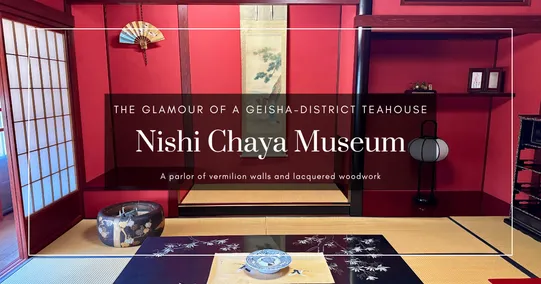
| Nishi Chaya Museum | Museum | 9:30 am–5:00 pm | Open year - round | Recreates a crimson teahouse banquet room. Free admission |
Two Houses Worth Visiting in Nishi Chaya District
Besides dining and sweets, Nishi Chaya District has two houses you can tour. One is a museum that recreates a teahouse banquet room normally closed to the public. The other is a house of ninja and samurai filled with genuine weapons.
Nishi Chaya Museum

The Nishi Chaya Museum is a free museum in Nishi Chaya District. The second floor recreates a lavish teahouse banquet room with walls painted bright crimson, while the first floor exhibits materials connected to Shimada Seijiro, the author whose novel “Chijo” (On the Ground) became a Taishō-era bestseller. The museum stands on the former site of “Kichibeiro,” the teahouse where Shimada spent his youth.
Read more about Nishi Chaya Museum
Ninja Weapon Museum

The Ninja Weapon Museum is an exhibition facility in Nishi Chaya District that gathers ninja and samurai weapons. Housed in a 100-year-old townhouse, it lets you view more than 100 genuine weapons and try shuriken throwing. It also has a shop where you can buy replica swords and ninja goods.
Read more about Ninja Weapon Museum

A Street Packed with Kaga Teahouse Culture: Streetscape, Sweets, and Geisha

Nishi Chaya District is a place where you can see, taste, and fully enjoy the world of the Kaga teahouse.
Along a single short street stand projecting-lattice teahouse buildings, long-established shops carrying on Kaga sweets, restaurants making the most of local ingredients, and the kenban where geisha still hone their arts. The history of the teahouse town and the present-day life and flavors all fit within walking distance.

It is also within walking distance of the Nagamachi Samurai District and Korinbo, making it easy to fold into a Kanazawa walking itinerary.
A Kanazawa geisha district where two centuries of teahouse culture still live on. Be sure to pay a visit to Nishi Chaya District.
