Kanazawa Ninja Temple Guide (Myoryuji): Hidden Traps and Secret Stairs of the Kaga Clan's Fortress

Contents
A “Ninja Temple” Hidden in Kanazawa: A Full Guide to Myoryuji and Its Many Traps

In the south of Kanazawa lies Teramachi, a district where nearly 70 temples stand close together. Myoryuji sits in one corner of it. With its tiled roof, wooden walls, and a quiet precinct beyond the gate, it looks like a calm, ordinary temple.
Yet locals call this temple by another name: the “Ninja Temple.”
Of course, no ninja ever lived here. So why is this one temple alone called the Ninja Temple? The answer is hidden inside the building, where it can never be seen from outside the gate.
This article covers why Myoryuji is called the Ninja Temple, what makes it worth seeing, and the reservation method you cannot skip if you want to visit.
Myoryuji (Ninja Temple)

Myoryuji is a temple of the Nichiren sect, a school of Japanese Buddhism, located in Kanazawa, Ishikawa Prefecture. Because its interior is filled with countless tricks and traps, it is fondly known as the “Ninja Temple,” and it draws crowds as one of Kanazawa’s signature sightseeing spots.
| Item | Details |
|---|---|
| Name | Myoryuji / nickname: Ninja Temple |
| Hours | 9:00 am–4:00 pm |
| Closed | January 1–2 and on memorial - service days |
| Admission | Adults (junior high and up) ¥1,200 / elementary school ¥800 / groups, visitors with disabilities, and school groups ¥1,000 (preschool children not admitted) |
| Phone | 076-241-0888 |
| Address | 1 - 2-12 Nomachi, Kanazawa, Ishikawa Prefecture |
| Access | About a 3 - minute walk from the Hirokoji bus stop |
| Official site | http://www.myouryuji.or.jp/ |
A Building Full of Traps: Why It Is Called the Ninja Temple
The reason it is called the “Ninja Temple” lies in the many tricks and traps built throughout its interior. The temple has no connection to actual ninja; its maze-like layout simply resembles a ninja’s hideout, and over time the nickname stuck.
From the outside, you would never guess what Myoryuji really holds. It looks like a two-story building, but inside it has four stories with seven levels. With 23 rooms and 29 staircases, it is built so that intruders cannot easily push their way deeper inside.

The devices are worked into the building everywhere. At the front entrance of the main hall, a pit trap is set into the floor, disguised as an offering box (saisen-bako).
There are others, too: a hidden staircase that appears when you lift the floorboards of a storeroom, and a corridor whose floorboards drop away to become a staircase-shaped pit trap.

At the very top of the main hall’s roof was a lookout tower once fitted with giyaman (antique glass), from which guards could scan the distant Kaga Plain and catch the enemy’s movements early.

There is also a well about 25 m (82 ft) deep, dug out of Tomuro stone, and a side tunnel at its bottom is said to have once led all the way to Kanazawa Castle.
So why would a single temple need so many of these devices? The answer lies in the situation of the Kaga Domain and the Maeda clan, who stood in a position of being closely watched as a tozama daimyo.
Myoryuji was built in 1643. Maeda Toshitsune, the third lord of the Kaga Domain, moved a temple that had stood near Kanazawa Castle to Teramachi and rebuilt it here.
Tozama daimyo were lords who submitted to the Tokugawa only after the Battle of Sekigahara (1600). As outsiders, and as the largest domain among them, the Maeda were closely watched by the shogunate and had to stay on guard so as never to show a weakness.
Maeda Toshitsune made the temple district a defensive stronghold for the castle town, and Myoryuji in particular is said to have been given the role of a fortress, ready for a crisis.
As Fun as a Theme-Park Attraction: The Guided Tour

You cannot wander the interior freely to see all the devices described above. Myoryuji offers a guided tour, and by joining it you get to experience the building’s tricks for yourself.
Reception opens 10 minutes before each tour’s start time, so gather in the precinct before then. You take off your shoes and place them in the shoe rack, confirm your reservation and pay, and then join the tour. There is a place inside to leave backpacks and other bags, so you can take the tour empty-handed.

The tour takes about 40 minutes. I had thought 40 minutes seemed long for walking through one building, but joining it was a surprise. With so many devices and such a strange interior structure, the 40 minutes flew by in an instant.
The tour splits into groups of about 10 people, and a staff member guides you and explains as you go. The staff member’s hospitality was wonderfully high, from the energy of the guiding to the care shown to each participant, and that genuine spirit of omotenashi was a real pleasure.
The explanations during the tour are given in Japanese, but visitors from abroad receive explanation boards translated into English and other languages. Even if you do not understand Japanese, you can take in the meaning of each device as you go. When I joined, there were many travelers from overseas as well.
Note that photography is not allowed inside. Come and see the many devices with your own eyes.

The Tour Is Reservation-Only: Booking Ahead Is the Sure Bet

The guided tour is by reservation only.
Reservations are taken by phone only. You can book starting one month in advance.
Phone reservations can be handled in simple English.
Visiting hours are 9:00 am to 4:00 pm. Within those hours, tours start every hour on weekdays and every 30 minutes on weekends and holidays. When you book by phone, check which start times are available on your preferred day and tell them the time you want.
If you do not make it to your tour’s start time, your reservation becomes void, so we recommend leaving plenty of time before your booked slot.
If you do not have a reservation, there is an intercom at the far left of the main hall where you can apply for a tour. However, this only works when a spot is open, so booking ahead is recommended. The tour is popular, so even if you show up on the day hoping to join, that day’s slots may already be full, so take care.

Cashless Payment Accepted: How to Pay for the Tour
The official site states that payment is cash only, but in fact, in addition to cash, credit cards, electronic money, and QR-code payments were all accepted.

| Category | Accepted payments |
|---|---|
| Credit cards | VISA, Mastercard, JCB, American Express, Diners Club, Discover, UnionPay, contactless |
| Electronic money | Apple Pay, Google Pay, iD, QUICPay+, Rakuten Edy, WAON, nanaco, transit IC (Suica, PASMO, etc.) |
| QR - code payment | PayPay, au PAY, Rakuten Pay, J - Coin, UnionPay QR, Alipay+, WeChat Pay, JKOPAY |
So Popular They Sell Out? The Adorable Dog Ema in the Precinct
The devices inside are the stars of Myoryuji, but the precinct holds one more thing that catches every visitor’s eye: rows upon rows of dog-shaped ema (votive plaques) hung across an entire wall.

The sight of ema shaped like Shiba Inu faces is endearing, and visitors love them. The same dog design even appears on a vending machine in the precinct.

Why are there dog ema at Myoryuji? They carry the heartfelt wish of the head priest, an unmatched dog lover. The Nichiren sect, to which Myoryuji belongs, holds that the life of the Buddha dwells in everything, from mountains and rivers to grass and trees, and embraces the motto “Inochi ni gasshō,” joining one’s hands in reverence for all life. The priest was pained by how many dogs and cats were being euthanized in Ishikawa Prefecture, and he kept up his prayers day after day. In time, a zero-euthanasia outcome that had once seemed impossible was achieved. There were also mysterious events, it is said: a dog lost from a faraway home suddenly appeared in the precinct and was safely taken in, and an ailing dog recovered. Out of these connections, and out of respect for life and a wish for the bond and happiness of people and animals, these ema were created. Part of the offering fee is donated to dog rescue groups within Ishikawa Prefecture.
You can see and buy the dog ema in the precinct even without joining the tour. In the past they were apparently so popular that production could not keep up, so whether you get to meet one is a little test of luck. Come with your hopes high.

Best Paired with the Nishi Chaya District
To reach Myoryuji, it is easiest to come by bus or taxi from places like Kanazawa Station. From the nearest bus stop, Hirokoji, it is about a 3-minute walk.

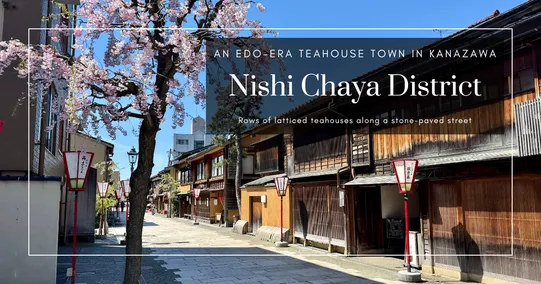
If you are visiting Myoryuji, we recommend pairing it with the nearby Nishi Chaya District. Nishi Chaya is one of Kanazawa’s three chaya (teahouse) districts, lined with townhouses fronted by latticed doors, and it is about a 3-minute walk from Myoryuji. You can stroll the district’s atmospheric streets and enjoy a Japanese sweet before heading to your reserved tour time at Myoryuji.
Read more about the Nishi Chaya District
The Kaga Clan’s Wisdom Hidden Behind an Ordinary Temple’s Face

What makes Myoryuji fascinating is the gap between its unassuming exterior and the devices hidden within. The ingenuity you could never notice from outside the gate reveals itself one piece at a time, along with the guide’s explanations. Built into each of those devices is the wisdom of the Kaga clan, who sought to survive as a tozama daimyo.
If you book the tour by phone in advance, you can join smoothly at the time you want, and pairing it with the Nishi Chaya District right next door makes for just the right amount for a half-day stroll through Kanazawa, so we recommend it.
A temple unique to Kanazawa, packed with surprises you would never imagine from its exterior. Be sure to pay Myoryuji a visit.
