- Kumamoto
- Kumamoto City
- Tourism
- Japanese castle
- 100 famous castles in Japan
- Three Great Castles of Japan
- Travel Plans
Kumamoto Castle Guide: Tickets, Highlights & How This Iconic Fortress Rose from the 2016 Earthquake

Contents
More Than Just the Castle Tower: A Complete Guide to Kumamoto Castle’s Best Spots
When you think of Kumamoto Castle, the main tower (tenshu) comes to mind first. But there are many equally captivating spots scattered around it.
From a museum where you can experience history through VR, to a food and souvenir street recreating a castle town, and even hidden gems known only to locals.
In this article, we’ll introduce a model itinerary to help you enjoy Kumamoto Castle even more, along with some hidden spots nearby.
Major Tourist Spots Related to Kumamoto Castle
Let’s start by organizing the major tourist spots related to Kumamoto Castle.

| Spot | Features |
|---|---|
| Kumamoto Castle | The fully restored main tower. "Going to Kumamoto Castle" typically means visiting the main tower |
| Kumamoto Castle Museum Wakuwaku-za | An interactive museum where you can learn about Kumamoto Castle's history in a fun way |
| Josaien | Lined with souvenir shops and restaurants. The tourist information center and lockers are also here |
| Statue of Lord Kato Kiyomasa | A symbol standing at the entrance of Kumamoto Castle |
| Kumamoto Castle Inari Shrine | A beautiful red and white shrine with ties to Kumamoto Castle |
| Takahashi Park | A hidden gem with monuments and remains of great figures from Kumamoto's modern history |
| Kumamoto City Hall Free Observation Deck | Panoramic views of Kumamoto Castle from the 14th floor. The night view is stunning |
| Kumamoto Prefectural Museum | Exhibits all of Kumamoto's history. Also hosts Kumamoto Castle - related events |
Easy Access from Kumamoto Station by Bus or Streetcar

From JR Kumamoto Station, you can easily reach Kumamoto Castle by bus or streetcar.
Kumamoto Castle Loop Bus
From bus terminal platform 2 at the Shirakawa-guchi (East Exit) of Kumamoto Station, the sightseeing bus "Shiromegurin" runs to Kumamoto Castle.

The ride takes approximately 23 minutes from Kumamoto Station. The fare is 200 yen for adults and 100 yen for children.
Shiromegurin TimetableGet off at the “Sakura-no-baba Josaien” bus stop. You’ll be dropped off right in front of the “Josaien” facility within the Kumamoto Castle grounds.


Streetcar

Streetcars run every 8 minutes. Unlike buses, you don’t need to worry about exact departure times. Just head to the station and wait—a streetcar will arrive shortly, making it very convenient.
Kumamoto City Transportation Bureau (Timetables and Route Maps)To go by streetcar from Kumamoto Station, take Line A from “Kumamoto-Ekimae Station”. The nearest stops are “Hanabata-cho Station” or “Kumamoto Castle/City Hall Station”. (Travel time: 17 minutes, 200 yen)
The distance from both stops is similar, but we recommend getting off at Kumamoto Castle/City Hall Station.

From Hanabata-cho Station, you walk through the city center to reach the castle entrance. However, from Kumamoto Castle/City Hall Station, you can walk along Kumamoto Castle’s Nagabei (long wall) and enjoy the castle town atmosphere on your way to the entrance.
The Nagabei is a 242-meter long wall built along the current Tsuboi River. It is designated as a nationally Important Cultural Property.

Parking Available for Drivers
If you’re visiting Kumamoto Castle by private car or rental car, there are parking lots on the grounds. The parking area is spacious, so finding a spot shouldn’t be a problem.
There are several parking lots at Kumamoto Castle, but the Ninomaru Parking Lot offers the best access to the main tower and has the most parking spaces.

| Item | Details |
|---|---|
| Standard vehicles | 210 spaces |
| Motorcycles | Approximately 10 spaces |
| Operating hours (April - October) | 8:00 am - 6:30 pm (Last entry 5:30 pm) |
| Operating hours (November - March) | 8:00 am - 5:30 pm (Last entry 4:30 pm) |


Convenient Lockers and Luggage Storage at the Tourist Information Center

Inside Josaien is a tourist information center where free and paid lockers are available. If the lockers are full, luggage storage service is also available.


| Type | Price | Hours | Notes |
|---|---|---|---|
| Free locker (small) | Free (100 yen refundable deposit) | 9:00 am - 5:00 pm | Perfect for regular backpacks |
| Free locker (large) | Free (100 yen refundable deposit) | 9:00 am - 5:00 pm | May not fit large suitcases |
| Paid locker (small) | 200 yen | 8:00 am - 10:30 pm | Only accepts 100 yen coins |
| Paid locker (medium) | 400 yen | 8:00 am - 10:30 pm | |
| Paid locker (large) | 500 yen | 8:00 am - 10:30 pm | |
| Luggage storage | Paid | 9:00 am - 5:00 pm | Available at the tourist information center |


Recommended: The Best Way to Explore Kumamoto Castle
Here’s a model itinerary for exploring Kumamoto Castle efficiently and affordably.
- Kumamoto Castle Museum Wakuwaku-za
- Kumamoto Castle
- Lunch & Souvenirs at Josaien
This itinerary takes approximately 3 hours.
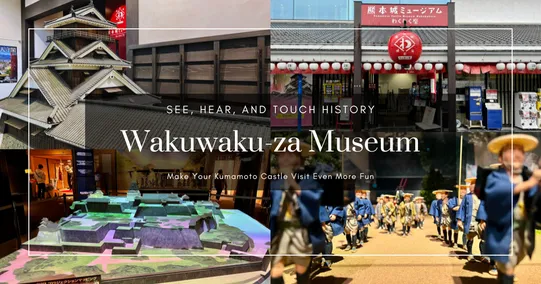
1. Kumamoto Castle Museum Wakuwaku-za
When you arrive at Kumamoto Castle, start with “Kumamoto Castle Museum Wakuwaku-za”. Wakuwaku-za is located inside Josaien.


For adults, admission to Kumamoto Castle is 800 yen and Wakuwaku-za is 300 yen. However, if you purchase the “Castle Full Experience Course” combo ticket for Wakuwaku-za + Kumamoto Castle, it’s only 850 yen, meaning you essentially pay just 50 yen for Wakuwaku-za.

Wakuwaku-za features interactive content including games, projection mapping, and large-screen VR. Even if you’re not particularly interested in history or castles, you’ll have a great time.

For more details about Wakuwaku-za, see below.
Read more about Kumamoto Castle Museum Wakuwaku-za
2. Kumamoto Castle
From Wakuwaku-za’s exit, there’s a passage leading directly to Kumamoto Castle, making access easy.


Special Viewing Route (South Route)
Head to Kumamoto Castle’s main tower via the South Route, which has been beautifully maintained and offers the best views.


You can see the Sukiya-maru Five-story Turret ruins, which are still under restoration.

Kumamoto Castle’s main tower has been fully restored and is completely revived.

Castles typically have the image of winding paths and many slopes that are difficult to walk, but the South Route has been beautifully renovated and is very easy to walk.


Niyo-no-ishigaki (Two-Style Stone Walls)
This is the “Niyo-no-ishigaki (Two-Style Stone Walls)“—one of Kumamoto Castle’s highlights where stone walls from two different eras overlap.

- Right side: Stone walls from the Kato Kiyomasa era
- Left side: Stone walls from the Hosokawa Tadatoshi era
The older stone walls with a gentler slope (right side) have newer stone walls with a steeper slope (left side) built on top. Comparing the characteristics clearly shows the evolution of stone-stacking techniques.

Underground Passage (Kuragari-tsuro)
To reach Kumamoto Castle’s main tower, you pass through an underground passage. This passage also leads to the Honmaru-goten (main palace).


After passing through the underground passage, you arrive at the main tower.


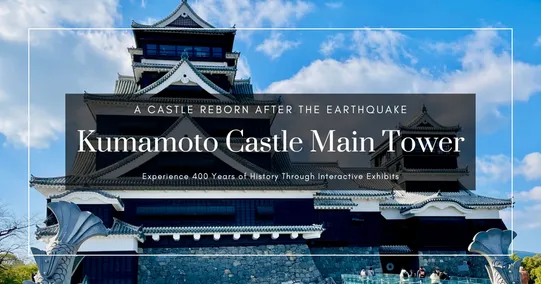
Kumamoto Castle Main Tower
Kumamoto Castle suffered major damage in the 2016 Kumamoto Earthquake, but the main tower has been fully restored and reopened as a complete renovation.

The exhibits have also been fully renovated, with enhanced facilities and comprehensive content. For a look inside the main tower, see below.
Read more about Kumamoto Castle Main Tower
Next to the main tower is a gift shop selling souvenirs.


3. Lunch & Souvenirs at Josaien

Josaien is a commercial facility lined with souvenir shops and restaurants. The tourist information center and Wakuwaku-za mentioned earlier are also located within Josaien.
Here you can buy souvenirs and enjoy lunch.


Restaurants
In addition to Kumamoto’s famous specialties, there are options for street food as well as sit-down restaurants.
For seafood, “Umimaru” is recommended.


For traditional Kumamoto cuisine, “Yamamichaya” is the place to go.


For Kumamoto ramen, head to “Yamamura”.

For desserts and cafe options like zenzai (sweet red bean soup), ice cream, and lattes, there’s “Izumi-cha”.

Perfect for Street Food: Uni Croquette
A must-try is the “Uni Croquette (Sea Urchin Croquette)” sold by “Umimaru”, the seafood restaurant mentioned earlier—perfect for eating while walking.


They’re incredibly creamy with a gentle sea urchin flavor—absolutely delicious.


Souvenirs
With a wide variety of products available, buying souvenirs here is a great choice.


Hidden Gem Tourist Spots Near Kumamoto Castle
For those who want to explore Kumamoto Castle even further, be sure to check out these spots. While all are well-known, they’re not as popular and remain hidden gems.
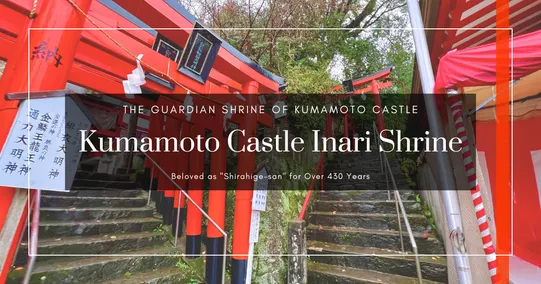
Kumamoto Castle Inari Shrine

This shrine was brought from Fushimi Inari Taisha in Kyoto when Lord Kato Kiyomasa entered as the ruler of Higo Province.
It’s just a few minutes’ walk from Kumamoto Castle. With its beautiful red and white colors, shrine enthusiasts will love it. The omamori (charms) and goshuin (seal stamps) here are popular among women. The shrine itself isn’t large, so you can easily visit as part of your Kumamoto Castle trip.
Read more about Kumamoto Castle Inari Shrine
Takahashi Park

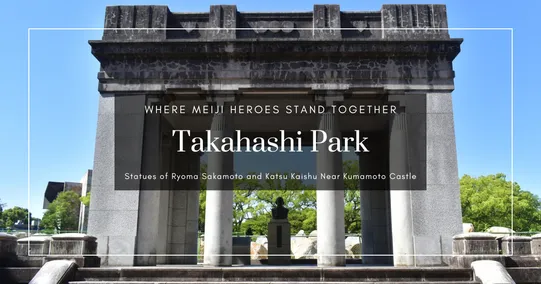
This park features statues and remains of great figures from Kumamoto’s modern history, including Sakamoto Ryoma and Katsu Kaishu—a must-visit hidden gem for history buffs.
It’s also just a few minutes’ walk from Kumamoto Castle, located right next to Kumamoto Castle Inari Shrine.
Read more about Takahashi Park
Kumamoto City Hall Free Observation Deck
On the 14th floor of Kumamoto City Hall is an observation lobby where you can enjoy panoramic views of Kumamoto Castle and the city for free.


While daytime views are nice, the night view is absolutely stunning, so we recommend going at night.
Read more about Kumamoto City Hall Free Observation Deck
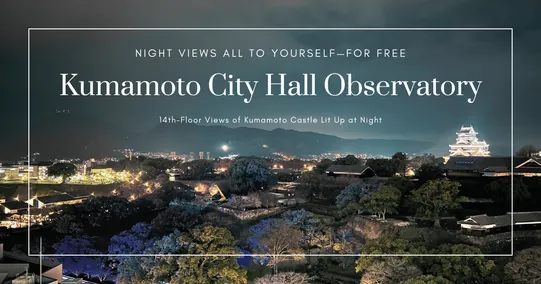
As mentioned in the detailed article, it’s close to the entertainment district, so you can easily walk there after dinner.
Kumamoto Castle: A Continuing Journey of Revival

Kumamoto Castle suffered major damage in the 2016 Kumamoto Earthquake, but with the complete revival of the main tower, the tourist spots around Kumamoto Castle are thriving once again.
Experience history at Wakuwaku-za, climb the restored main tower, and savor Kumamoto cuisine at Josaien. Extend your visit to hidden gems like Kumamoto Castle Inari Shrine and Takahashi Park, plus the City Hall observation deck with its beautiful night views—your Kumamoto Castle experience will be all the more enriching.
Restoration work at Kumamoto Castle is still ongoing, but we encourage you to witness with your own eyes this fortress’s continuing journey of revival.
