- Okinawa
- Naha City
- Tourism
- Japanese castle
- 100 famous castles in Japan
- World Heritage Sites
- Michelin Green Guide Japan
Modern Approaches to Castle Restoration: How Shuri, Kumamoto, and Osaka Make History Accessible

Contents
Some Castles Are Enjoyable Even Without Historical Knowledge
Castles are one of Japan’s most iconic tourist attractions.
Scattered throughout the country, these castles tell the story of their region’s history and draw visitors from both Japan and abroad.
However, not all castles provide the same level of enjoyment.
Some castles leave visitors thinking “that was fun” even if they have little knowledge of history, while others end with just “I saw it, I guess.” What makes the difference?
Through my travels visiting castles across Japan, I’ve come to believe the answer lies in the presence or absence of “modern approaches.”
In this article, I’ll examine how castles can effectively convey their appeal to visitors, focusing on Shuri Castle’s restoration alongside examples from Kumamoto Castle, Osaka Castle, and Odawara Castle.
Historical Value Alone Isn’t Enough to Reach a Wide Audience
Castles fascinate history enthusiasts regardless of whether they feature original or reconstructed keeps.
As someone who loves Japanese history and castles myself, I’m convinced that the more knowledge you have—about stone wall construction techniques, castle layout strategies, and architectural styles—the richer your experience becomes when visiting a castle.
However, for visitors without much historical knowledge, the value of these sites often fails to come across.
Steep staircases, dimly lit interiors, and difficult-to-understand exhibit materials.
Why are the stairs so steep? Why are there no windows on this floor?
Many visitors leave thinking “I came because it’s famous” and nothing more.
But this isn’t a problem with the castles themselves—it’s a challenge in how their value is communicated.
Through my travels, I’ve come to think that whether a castle has original or reconstructed structures matters less than whether it employs modern approaches in determining visitor satisfaction.
“Delivering Value” Means “Sparking Interest”
So what exactly are modern approaches?
It’s not about “conveying value”—it’s about “sparking interest.”
Take information boards, for example.
While information boards serve the purpose of preserving knowledge at the site, they typically display academic explanations that few visitors—unless they’re castle or history enthusiasts—actually stop to read carefully.
Without absorbing information about a spot before viewing it, most visitors end up just looking and moving on.
Information boards certainly serve the purpose of preserving knowledge, so they can stay as they are. But different approaches to communication are needed.
I believe one key modern approach is video content.
Visual approaches through video are accessible to everyone, and depending on the content, can engage even visitors with little interest in history or castles.
When this sparks curiosity, visitors become interested in learning more about the castle, its history, and the region.
Beyond video, hands-on experiences like trying on samurai armor or collecting stamps, as well as barrier-free facilities that allow wheelchair users to access castle towers, are also modern approaches that spark interest and improve visitor satisfaction.
Through observing visitors at various castles, I’ve come to feel that by “sparking interest” rather than “directly conveying information,” we can ultimately enhance satisfaction with castle tourism.
Case 1: Modern Approaches in Shuri Castle’s Restoration
In the early morning of October 31, 2019, a fire broke out at Shuri Castle in Naha City, Okinawa, destroying the main hall and eight other structures.

Shuri Castle served as the royal palace of the Ryukyu Kingdom from the 15th to 19th centuries and was registered as a UNESCO World Heritage Site in 2000. The fire was a tremendous loss not only for Okinawa but for all of Japan.
However, modern approaches have been explicitly incorporated into Shuri Castle’s restoration.
A Policy of “Restoration You Can See, Learn From, and Enjoy”
The ”Shuri Castle Restoration Master Plan,” formulated by Okinawa Prefecture in March 2021, explicitly states a policy of “restoration you can see, learn from, and enjoy.”
This approach involves opening the restoration process itself as tourism content and engaging visitors in the recovery process.
“Visible Restoration” in Practice
Shuri Castle established a “Temporary Roof Viewing Area” during the main hall’s reconstruction (open until June 2025). Visitors could observe master carpenters using traditional techniques to rebuild the hall up close—a rare and valuable experience.

Opportunities to see traditional construction techniques up close are extremely rare. This was an excellent initiative that created reasons to visit Shuri Castle Park even during restoration.
The Shuri Castle Restoration Exhibition Room displays videos and explanatory panels that are updated as construction progresses. At Yohokuden Hall, large monitors introduce the history of the Ryukyu Kingdom, and touchscreens allow visitors to explore 3D images of the restored Shuri Castle.
Utilizing Digital Technology
Digital transformation (DX) is being actively incorporated into Shuri Castle’s restoration.
Okinawa Prefecture has signed a “Partnership Agreement for DX Utilization in Shuri Castle Restoration” with SCSK Corporation and operates the “Shuri Castle Restoration DX Co-creation Lab.” Development is underway for interactive content utilizing digital technology, including 3D restoration models and Shuri Castle reconstructed in metaverse spaces.
Recreating the “Red of Ryukyu”
The main hall’s exterior was completed in summer 2025, with walls painted using naturally-derived red pigment called “Kushimagiri Bengara.” The vibrant “red of Ryukyu,” which was difficult to achieve in the previous Heisei-era restoration, has been faithfully reproduced.
Interior work continues toward the main hall’s scheduled completion in autumn 2026.
Case 2: Kumamoto Castle’s Rebirth After Disaster

Kumamoto Castle’s restoration is another excellent example of modern approaches.
The April 14 and 16, 2016 Kumamoto earthquakes caused severe damage to Kumamoto Castle. Thirteen Important Cultural Properties and multiple reconstructed buildings collapsed or were damaged, with approximately 10% of the stone walls collapsing.
While complete restoration of Kumamoto Castle is projected for 2052, the main tower’s restoration was completed in 2020 and reopened to the public in 2021.
Barrier-Free Access
The path to the castle tower has been completely redesigned with barrier-free access.

Inside the tower, staircases have been made one-way for ascending and descending, with handrails installed. Japanese castle stairs are typically steep and narrow, making such improvements impossible if the original structure had been preserved.

Video Content and Projection Mapping
Content on each floor has been completely reorganized. The essence of information design has been refined within the exhibit format, incorporating videos, models, artifacts, and explanatory texts.


These modern approaches help visitors better understand the history of the place.
Even visitors without initial interest become curious, and the accessible, engaging video content creates “aha moments” that start from a simple “this looks interesting.”
By the time visitors leave Kumamoto Castle’s tower, many feel they’ve had a genuinely enjoyable experience.
Cases 3-4: Osaka Castle and Odawara Castle’s Approaches to “Showcasing”
Modern approaches can be implemented even without disaster restoration. Let’s look at examples from Osaka Castle and Odawara Castle.
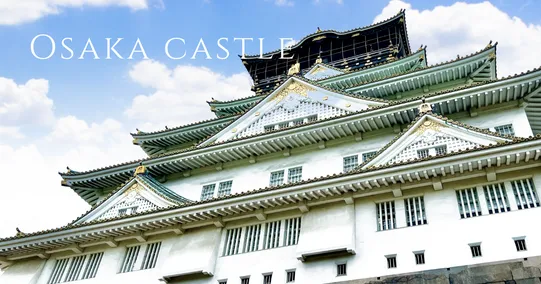
Osaka Castle: A Fully Barrier-Free Castle Tower

Osaka Castle’s tower was rebuilt in reinforced concrete in 1931 and underwent major renovation in 1997.
Most notably, it is one of Japan’s few fully barrier-free castle towers.
- Indoor elevators (floors 1-5)
- Outdoor elevator (transparent shaft beside stone walls, direct access to 8th floor observation deck for wheelchair users)
- Five wheelchairs available for free loan
- Free audio guides (Japanese, English, Korean, Chinese)
- Multilingual staff stationed on floors 1 and 5

The castle also operates as a fully-fledged museum with curators on staff and approximately 8,000 items in its collection, including Important Cultural Properties. Video content about Toyotomi Hideyoshi and Osaka Castle (approximately 5 minutes each, with subtitles in 4 languages) is shown continuously. 3D stereoscopic video content like the following also captivates visitors.

Helmet and armor try-on experiences (500 yen) allow visitors to wear replica armor of Toyotomi Hideyoshi and Sanada Yukimura.

Odawara Castle: Complete Exhibit Renewal Through Seismic Retrofit

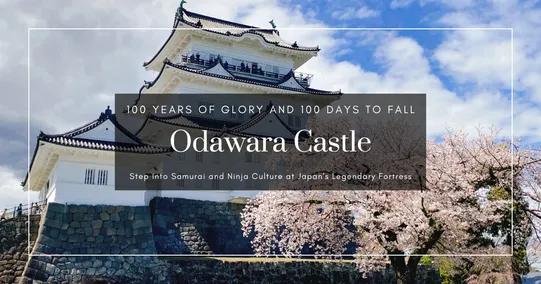
Odawara Castle’s tower was reconstructed in 1960 and underwent seismic retrofitting in 2016, more than 50 years later.
This renovation provided an opportunity for a complete exhibit overhaul.
- 1st floor: “Odawara Castle in the Edo Period”
- 2nd floor: “Odawara Castle in the Warring States Period”
- 3rd floor: “Art and Crafts of Odawara”
- 4th floor: “Odawara Castle Through the Ages”
- 5th floor: “Recreation of the Marishiten Shrine Space”
Along with significantly expanded graphic explanations and enhanced video content, hands-on experiences including tiger seal stamping, armor try-ons, and 3D face cutouts have been added.
The “Tokiwagi Gate SAMURAI Museum,” which opened around the same time, features exhibits focused on weapons and armor, introducing the spirit of the samurai and the artistic beauty of weaponry.

Odawara Castle’s example demonstrates that modern approaches can be introduced through regular renovation, not just disaster recovery.
Cultural Heritage Restoration as an Opportunity for Tourism Development
Of course, the destruction or loss of historically valuable cultural properties in disasters is tragic.
However, restoration also presents an opportunity for tourism development.
“Preserving Historical Value” and “Enhancing Tourism Value” Can Coexist
As the examples of Kumamoto Castle, Shuri Castle, and Odawara Castle show, restoration and renovation are not merely about “returning to the original state.”
Barrier-free modifications to meet modern needs, exhibits utilizing video technology, and interactive content—these approaches allow both the preservation of historical value and the enhancement of tourism value. Restoration is an opportunity to “make things better.”
- “Visible restoration” turns the restoration process itself into tourism content
- Barrier-free access welcomes a wider range of visitors
- Video and digital technology spark interest
- Interactive content improves satisfaction
- Multilingual support caters to international visitors
By incorporating these modern approaches, sites can evolve from “places of historical value” to “excellent tourism resources.”
Conclusion: “That Was Fun” Becomes the Gateway to History
Shuri Castle’s restoration is progressing steadily toward the main hall’s completion in autumn 2026.
Under the policy of “restoration you can see, learn from, and enjoy,” modern approaches including “visible restoration” and DX utilization are being actively incorporated.
As Kumamoto Castle has demonstrated, modern approaches generate interest in history.
From “I just saw it” to “that was fun, I want to learn more.”
When castle visitors leave thinking “that was fun,” it becomes a gateway to interest in the region’s history and culture.
Personally, as someone who travels Japan and loves history and castles, I deeply appreciate learning from academic explanations on information boards. They’re incredibly satisfying to read, and the experience of “knowing, then actually seeing” brings great fulfillment.
At the same time, I strongly feel that modern approaches can elevate castle tourism satisfaction to another level.
Children’s eyes lighting up as they watch videos, and their parents and grandparents smiling at the sight.
Visitor-friendly facilities that make history accessible even to those with mobility challenges.
Opportunities for international visitors who traveled all the way to Japan to fully experience the history and culture they came to appreciate.
I look forward to Shuri Castle becoming a “fun castle” just like Kumamoto Castle.
