Shinbutsu-Shugo Explained: Why Shinto and Buddhism Shared the Same Ground for 1,200 Years

Contents
Shinto and Buddhism: A History of Coexistence
Japan has shrines and temples.
Shrines belong to Shinto; temples belong to Buddhism.
Today they are separate institutions, but there was a time when the two occupied the same ground.
Buddhist temples stood within shrine precincts, and Shinto shrines were enshrined within temple grounds. This arrangement, known as Shinbutsu-shugo (the syncretism of Shinto and Buddhism), lasted for more than 1,200 years.
How could two different religions become one? This article traces the background and history behind that remarkable coexistence.
What Is Shinbutsu-shugo?

Shinbutsu-shugo is a form of religious practice in which Japan’s indigenous faith in the gods (Shinto) and the foreign religion of Buddhism did not oppose each other but instead absorbed one another, gradually becoming intertwined. It is also called Shinbutsu-konko.
After Buddhism was introduced to Japan in the 6th century, Shinto and Buddhism forged a unique relationship that endured until the Meiji government issued the Shinbutsu Bunri decree (Separation of Shinto and Buddhism) in 1868. During that long period, many distinctive philosophies, institutions, and forms of worship emerged that explained gods and buddhas within a single worldview.
The Beginnings of Shinbutsu-shugo
In the 6th century, Buddhist statues and sutras arrived from across the sea. That encounter became the starting point for what would become Shinbutsu-shugo.
The Arrival of Buddhism

In 538 CE (some sources say 552 CE), Buddhist statues and sutras were sent from Baekje on the Korean Peninsula to Japan, marking the formal introduction of Buddhism.
At the time, the Japanese perceived the Buddha as a banshin (foreign deity) — a god that had come from overseas.
Rather than seeing Buddhism as a separate, independent religion, they regarded the Buddha as a new kind of god, similar to the ones they already worshipped. This perception laid the groundwork for the later development of Shinbutsu-shugo.
Acceptance, however, was far from smooth. Two powerful clans at the imperial court clashed fiercely. The Soga clan, a powerful family with close ties to Korean immigrants, pushed for Buddhism. The Mononobe clan, who held traditional ritual authority, opposed it. The Soga clan ultimately prevailed, and under Empress Suiko, Buddhism was promoted as a matter of state policy.
Shrines and Temples Draw Closer

As the Nara period (8th century) began, Buddhist temples started to be built alongside Shinto shrines throughout the country.
Behind this trend was a distinctive belief called Shinshin ridatsu (the idea that gods also suffer and seek Buddhist salvation).
“Even the gods, who live for near-eternity, carry suffering within them.”
“They wish to be freed from that suffering through the teachings of the Buddha.”
Such oracles, attributed to the gods themselves, were reported at various shrines, prompting a movement to build Buddhist facilities next to them.
The idea that an all-powerful being would seek salvation is something uniquely characteristic of the Japanese religious worldview.
The pioneer of this movement was Usa Hachiman Shrine in Oita Prefecture.
In 749 CE, while the great project of constructing the Great Buddha at Todaiji Temple in Nara was underway, an oracle arrived from distant Usa in Kyushu: “The great god Hachiman will lead the gods of the entire land in lending their support.”
A Shinto shrine had offered to assist a Buddhist temple’s monumental project.
This event demonstrated to the nation that there was no longer any wall between gods and buddhas. Even before this, Usa Hachiman Shrine had built Mirokuji Temple around 720 CE to atone for the killing during the Hayato Rebellion, so the groundwork for gods and buddhas working hand in hand was already in place.
The Spread of Esoteric Buddhism and Deepening Ties

In the Heian period (from the 9th century onward), two monks who had studied Esoteric Buddhism in Tang China returned to Japan and transformed Japanese Buddhism: Saicho, who founded Tendai Buddhism, and Kukai, who founded Shingon Buddhism.
Esoteric Buddhism (the practice systems of Shingon and Tendai) placed great emphasis on rigorous ascetic training in the mountains. In Japan, where mountains had long been revered as places where gods dwell, the mountain practices of Esoteric Buddhism naturally overlapped with the mountain worship of Shinto, deepening the bond between gods and buddhas even further.
From Tendai Buddhism emerged Sanno Shinto, which linked the faith with the guardian deity of Mt. Hiei at Hiyoshi Taisha Shrine. From Shingon Buddhism came Ryobu Shinto, which interpreted the Shinto gods through the lens of Esoteric Buddhist mandala cosmology.
- Sanno Shinto: A Tendai Buddhist doctrine holding that the guardian deity of Mt. Hiei (the god of Hiyoshi Taisha Shrine) is a manifestation of a buddha
- Ryobu Shinto: A Shingon Buddhist doctrine holding that Japan’s gods are manifestations of Esoteric Buddhist deities
Why Did Shinto and Buddhism Become Intertwined?

Both political and religious factors contributed to the formation of Shinbutsu-shugo.
Politics provided the initial impetus.
The Soga clan used Buddhism to expand their power base, and the imperial court promoted Buddhism as a state policy for national protection. As a result, Buddhism took root in Japan as a pillar of the state.
However, it was not merely political backing that made it take hold.
Shinto is a polytheistic faith, symbolized by the concept of yaoyorozu no kami — eight million gods. There was no resistance to welcoming new deities, so the Buddha, arriving from overseas, was readily accepted as a powerful new god.
Furthermore, Shinto had no specific founder or scripture, and it lacked a systematic framework for answering questions like “Why do people suffer?” or “What happens after death?” Buddhism filled that role, while Shinto continued to serve as the faith rooted in the land and the natural world.
In this way, the two coexisted within a single system of belief.
Honji Suijaku: The Theory That United Gods and Buddhas

The coexistence of gods and buddhas eventually came to be supported by a grand theoretical framework. This was the Honji suijaku theory (the theory that Japanese gods are manifestations of Buddhist deities), established between the late 10th and 11th centuries.
In a nutshell, this theory holds that “Japan’s gods are Buddhist deities who changed their form to appear in this land.” Honji (true form / original Buddhist deity) refers to the buddhas and bodhisattvas in their original state. Suijaku (manifested form / Japanese god) means to “leave traces” — that is, to appear in a temporary guise while concealing one’s true form.
The local god you have been praying to is actually a manifestation of a great buddha from India. This idea had the power to unite every shrine and temple in Japan within a single worldview.
Specifically, the true form of Amaterasu (the sun goddess) was identified as Dainichi Nyorai (Mahavairocana), and the true form of Hachiman (the god of war) as Amida Nyorai (Amitabha). In this way, a corresponding buddha was assigned to each local deity across the country.
| God (Suijaku) | Buddha (Honji) |
|---|---|
| Amaterasu | Dainichi Nyorai (Mahavairocana) |
| Hachiman | Amida Nyorai (Amitabha) |
| Ichikishimahime | Benzaiten (Saraswati) |
| Chief deity of Kumano Hongu | Amida Nyorai (Amitabha) |
| Chief deity of Kumano Nachi | Senju Kannon (Thousand - Armed Kannon) |

In the Kamakura period, however, counterarguments to this theory emerged.
The Reverse honji suijaku (Shinpon butsujaku) theory held that the gods are the true entities and the buddhas are merely their temporary forms.
Ise Shinto, led by the Watarai clan who administered the Outer Shrine of Ise Grand Shrine, and Yoshida Shinto, systematized by Yoshida Kanetomo in the Muromachi period, both adopted this position. Each placed Shinto above Buddhism, and these ideas would later pave the way for the separation of Shinto and Buddhism.
The End of Shinbutsu-shugo

In 1868, the Meiji government sought to build a nation-state centered on the emperor and placed Shinto at its core. To that end, it issued the Shinbutsu Bunri decree (Separation of Shinto and Buddhism). Shrines and temples that had been united for 1,200 years were forcibly torn apart.
Under the decree, Buddhist statues and ritual objects were removed from shrines, and monks were barred from managing shrine affairs. In some cases, the very deities enshrined were replaced.
Kyoto’s Gion-sha is a telling example. Gozu Tenno, a deity of Buddhist origin who had been worshipped for more than 1,000 years, was overnight replaced by Susanoo from Japanese mythology, and the shrine’s name was changed to Yasaka Shrine. (Yes, the very same Yasaka Shrine that is one of Kyoto’s most popular sightseeing destinations.)
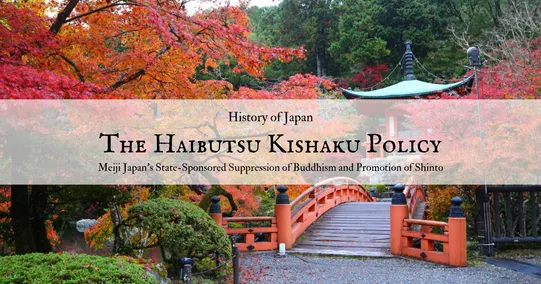
The decree itself aimed only to “separate,” not to “destroy.” On the ground, however, things spiraled out of control, and a wave of destruction known as Haibutsu kishaku (anti-Buddhist movement) swept across the country, targeting Buddhist structures.
Kofukuji Temple in Nara suffered particularly severe damage. Many Buddhist statues were burned, and the famous five-story pagoda — now a National Treasure attracting countless visitors — was actually put up for sale at the time so its metal fittings could be salvaged for scrap. Fortunately, no buyer came forward, and the pagoda survived, but it easily could have been lost.
Uchiyama Eikyuji Temple in Tenri City, Nara Prefecture, was not so lucky. Once a great temple rivaling Todaiji and Kofukuji in scale — praised as the “Nikko of the West” — it was completely demolished. Today, only a pond and a stone monument remain on its former grounds.
Read more about Haibutsu kishaku (anti-Buddhist movement)
Traces of Shinbutsu-shugo That Survive Today
More than 150 years after the Meiji-era separation, memories of Shinbutsu-shugo remain throughout Japan.
Jinguji: A Buddhist Temple Within a Shinto Shrine
A Buddhist temple built within a shrine’s precincts — this is called a Jinguji (Buddhist temple within a Shinto shrine). The head monk who administered the shrine was called a Betto (head monk administering a shrine), and the temple itself was also known as a Betto-ji.

Wakasa Jinguji Temple in Obama, Fukui Prefecture, is a rare surviving example. Despite being a Buddhist temple, its main hall is adorned with shimenawa (sacred rope), a distinctive marker normally found only at Shinto shrines. Inside the inner sanctuary, Buddhist statues and Shinto deity scrolls share the same space. Even the manner of worship is Shinto-style — visitors clap their hands in prayer, despite being in a temple. Here, you can still feel the atmosphere of an era when gods and buddhas lived side by side.

Tsurugaoka Hachimangu Shrine in Kamakura was also once known as “Tsurugaoka Hachiman-gu-ji” — a combined shrine-temple with resident monks managing both institutions as one. The Meiji-era separation thoroughly purged all Buddhist elements, and today almost no trace of that history remains within the grounds. However, the Kamakura Museum of National Treasures houses Buddhist statues that once belonged to the shrine-temple, offering a window into its past.
Chinju-sha: A Shinto Shrine Within a Buddhist Temple
The reverse pattern also exists. A Chinju-sha (guardian shrine within a Buddhist temple) is a Shinto shrine enshrined within temple grounds to serve as its protector.

Tamukeyama Hachimangu Shrine, located within the precincts of Todaiji Temple in Nara Prefecture, was established to enshrine the god Hachiman as a guardian deity in recognition of his assistance in the construction of the Great Buddha.

Nearby, Kasuga Taisha Shrine in Nara stands adjacent to Kofukuji Temple. Although its origins differ from a typical Chinju-sha, the two institutions were worshipped as a unified pair — the clan temple and clan shrine of the Fujiwara family — and eventually Kofukuji monks came to manage the rituals at Kasuga Taisha.
Both are excellent examples of an era when the boundaries between temples and shrines did not exist.
Gongen Worship

Gongen (manifestation of a Buddhist deity as a Shinto god) literally means “appeared provisionally.” It refers to a buddha who took the form of a Japanese god in order to save the people of Japan. Gongen worship was a concrete expression of faith born from the Honji suijaku theory.
The Kumano Gongen of the Kumano Sanzan (Three Grand Shrines of Kumano), the Shugendo principal deity Kongo Zao Gongen, and Tosho Daigongen — the divine title given to Tokugawa Ieyasu — are the most well-known examples.
For instance, when you visit Nikko Toshogu Shrine, you will find a five-story pagoda standing within the shrine grounds and a hall enshrining Yakushi Nyorai (the Honji-do, famous for its “crying dragon” ceiling). The reason Buddhist architecture exists inside a Shinto shrine is precisely this Gongen worship — Ieyasu was enshrined as a Gongen.
“Why does a Shinto shrine like Nikko Toshogu have Buddhist architecture?” The answer lies in the history of Shinbutsu-shugo.
Shugendo

Shugendo (mountain asceticism) is a uniquely Japanese faith born from Shinbutsu-shugo.
Practitioners enter mountains long revered as places where gods dwell, and through the rigorous practices of Esoteric Buddhism (Tendai and Shingon), they seek to attain superhuman powers. It is a crystallization of Shinbutsu-shugo — the unity of Shinto mountain worship and Buddhist ascetic discipline.
These practitioners, known as Yamabushi (mountain ascetics), don white robes and carry out their training while sounding horagai (conch-shell trumpets) through the mountains. You can still witness this tradition today at Mt. Omine in Nara Prefecture, Dewa Sanzan (Three Mountains of Dewa: Mt. Haguro, Mt. Gassan, and Mt. Yudono) in Yamagata Prefecture, and Mt. Hikosan in Fukuoka Prefecture.

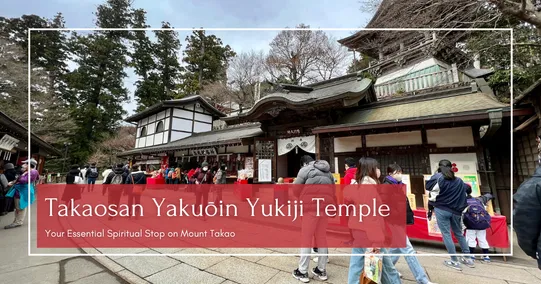
For those looking for an easily accessible site from Tokyo, Takaosan Yakuoin Temple in Hachioji is well known as a Shugendo temple. A torii gate stands along the approach, and beyond it lies the main shrine dedicated to Izuna Daigongen. The principal deity, Izuna Daigongen, is an entity born from the blending of Buddhism and Shinto, making this one of the best places to experience Shinbutsu-shugo firsthand.
Read more about Takaosan Yakuoin Temple
Traces in Festivals and Daily Life
The legacy of Shinbutsu-shugo lives on not only in architecture and historic sites but also in Japan’s festivals and the rhythms of everyday life.

Kyoto’s Gion Matsuri — one of Japan’s three most famous festivals, held every July — originally began as a Buddhist ritual to ward off plague. Even though the enshrined deity was changed from Gozu Tenno to Susanoo, the festival’s origins still bear the imprint of Shinbutsu-shugo.
Looking even closer to everyday life, the way Japanese people live throughout the year reveals the lingering influence of this syncretism.
On New Year’s Day, people visit a shrine for hatsumode (first shrine visit of the new year). In summer, they hold Obon (Buddhist festival honoring ancestors’ spirits) ceremonies. When a baby is born, the family takes it to a shrine for omiyamairi (baby’s first shrine visit). When someone dies, most funerals follow Buddhist rites.
Many Japanese people describe themselves as non-religious, yet they naturally move between Shinto and Buddhism in their daily lives.
This is not a deliberate choice. It is the result of the long coexistence of Shinto and Buddhism having seeped into the Japanese sense of the sacred.

The Seven Lucky Gods (Shichifukujin) — seven deities worshipped together for good fortune — perfectly embody this sensibility.
Ebisu comes from Japanese Shinto. Daikokuten, Benzaiten, and Bishamonten originate from Indian Buddhism. Jurojin and Fukurokuju come from Chinese Taoism. Hotei is modeled after a Zen Buddhist monk.
Seven deities of completely different origins, all riding together on a single treasure ship. The fact that this blend feels perfectly natural may be the greatest legacy Shinbutsu-shugo has left behind.
A Land Where 1,200 Years of Gods and Buddhas Still Breathe

Looking back at Japan’s religious history, it becomes clear that shrines and temples were “one” for far longer than they have been “separate.” The clear distinction we see today is merely a line drawn in 1868.
Politics promoted Buddhism, Shinto accepted it, and the Honji suijaku theory wove both into a single worldview. The Shinbutsu-shugo that emerged from all of this was the standard form of Japanese religious life until the Meiji-era Shinbutsu Bunri decree severed the bond.

Temples with torii gates. Shrines with five-story pagodas. Statues of gods dressed as monks.
What may seem like contradictions are, in fact, remnants of the most natural form of Japanese faith.
Shrines within temples, temples within shrines, and shrines and temples standing side by side.
If you encounter any of these on your travels through Japan, take a moment to sense the history of Shinbutsu-shugo — the remarkable story of how gods and buddhas shared this land together.

References
- Yoshie Akio, Shinbutsu Shugo (Iwanami Shinsho, 1996)
- Yoshida Kazuhiko (ed.), A History of Shinbutsu Syncretism in East Asia (Nagoya University Press, 2019)
- Yoshida Kazuhiko, The Reception of Buddhism and the Formation of Kami Worship (Journal of Religious Studies, Vol. 81, J - STAGE)
- Britannica, Shinbutsu - shugo
- National Archives of Japan, Shinbutsu Bunri decree
- Nara Prefecture, Uchiyama Eikyuji Temple
- Usa Jingu Shrine, Shinbutsu - shugo
- Kofukuji Temple, History (Part 4)
- Tanzan Shrine, History

