Kanazawa Curry Guide: 5 Iconic Restaurants and the History Behind Ishikawa's Soul Food

Contents
A Beloved Regional Curry with a Style All Its Own

When people talk about Kanazawa food, the first things that come to mind are sushi and other seafood specialties. Crab, nodoguro (rosy seabass), shrimp — Kanazawa is a port city blessed with an abundance of fresh ocean treasures.
But quietly thriving alongside that seafood reputation is another local favorite that has been beloved here for half a century. It is called Kanazawa Curry.
The unique style was created by a single chef more than 60 years ago. Passed down across generations, his recipe has built a family tree of celebrated curry shops throughout the region.
In this article, we will introduce the defining features of Kanazawa Curry, its history, and the most popular restaurants where you can taste it.
What Is Kanazawa Curry?
Kanazawa Curry is a distinctive style of curry rice served at specialty curry shops in and around Kanazawa, in Japan’s Hokuriku region. It is far more than simply “curry from Kanazawa” — it refers to a specific style defined by five features that set it apart from any other Japanese curry.

| Feature | Description |
|---|---|
| Rich, thick roux | A long - simmered, viscous roux in a deep brown that is almost black |
| Shredded cabbage | Almost always served alongside the roux |
| Stainless steel plate | Served on a boat - shaped stainless plate, never on ceramic |
| Fork or spork | Eaten with a spork (split - tip spoon) or fork instead of a regular spoon |
| Cutlet with sauce | A pork cutlet sits on top of the roux, finished with a drizzle of sauce |
This style took shape gradually, beginning when Yoshoku (Western-style Japanese cuisine) restaurants started serving the popular curry and pork-cutlet teishoku (set meal) together on a single plate.
The thick, near-black roux is made by slow-simmering vegetables such as onions and carrots together with beef for many hours. A finishing touch of caramelized sugar gives it its distinctive deep color and a layered sweetness. The longer it simmers, the more the ingredients melt together into a viscous, glossy sauce.
The boat-shaped stainless plate was chosen for purely practical reasons. It is more durable than ceramic, less likely to break, and easier to handle in busy yoshoku kitchens that need to serve dishes quickly.
The sauce poured over the cutlet is a clear remnant of yoshoku tradition. In old yoshoku restaurants, tonkatsu (pork cutlet) was always topped with Worcestershire sauce, and that habit carried over even after curry and cutlet were combined on one plate.
The shredded cabbage also comes from yoshoku set-meal culture, where tonkatsu always came with a generous side of raw shredded cabbage. Even after the dish merged with curry, the cabbage stayed.
And finally, the fork or spork. This was a clever solution that lets diners enjoy both the curry rice and the cutlet without juggling separate utensils.
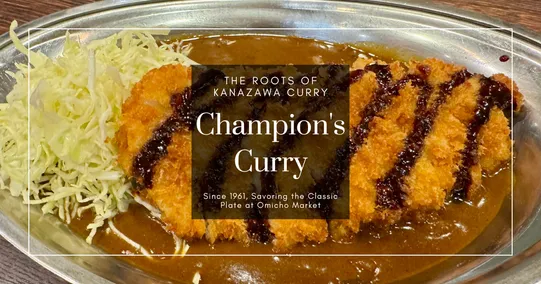
A boat-shaped stainless plate piled with rich black roux, a cutlet topped with sauce, a mound of shredded cabbage, and a humble spork on the side. Every element of Kanazawa Curry’s signature style was born from the practical wisdom of running a busy yoshoku restaurant.
The 5 Restaurants You Need to Know
When talking about Kanazawa Curry, there are five restaurants you simply cannot leave out. Each has been beloved as local soul food for decades, and each has shaped the culture in its own way — through history, nationwide visibility, or a unique twist on the recipe.
- Curry no Champion (Champion’s Curry, founded in 1961)
- Kitchen Yuki (1966)
- Curry no Shimin Alba (1971)
- Turban Curry (1971)
- Go Go Curry (2003 – 2004)
Curry no Champion (Champion’s Curry)

Curry no Champion is the long-established shop widely recognized as the original creator of Kanazawa Curry. Its roots go back to 1961 (Showa 36), when founder Yoshikazu Tanaka opened a yoshoku restaurant called Yoshoku Tanaka in the Takaoka-cho neighborhood of Kanazawa.
The curry that Tanaka developed there became the prototype for everything later known as Kanazawa Curry. In 1971 he co-founded Turban Curry with one of his regular customers, Takashi Okada, but the two split as business partners in 1973. Tanaka continued his shop under the name Tanaka no Turban, and in 1996 he renamed it to the current Curry no Champion.
The rich, deep flavor has earned a place as soul food for the people of Ishikawa, where locals fondly call it “Chankare” (チャンカレ). Note that the shop name “Curry no Champion” and the dish name “Champion’s Curry” refer to the same thing — the shop is officially Curry no Champion, while the curry it serves is called Champion’s Curry.

The main shop is located in Nonoichi City, but for travelers exploring Kanazawa, the Omicho store in central Kanazawa (basement level of Omicho Ichiba-kan, beneath Omicho Market) is the most convenient and highly recommended option.
Read more about Champion s Curry Omicho Store
Kitchen Yuki
Kitchen Yuki is a long-established yoshoku restaurant founded in 1966 (Showa 41). Founder Yukio Miyajima opened the original shop in the basement of a building in front of Kanazawa Station. The name “Yuki” comes from the nickname his senior colleagues used for him during his apprenticeship.
When the restaurant first opened, Tanaka and his team at Yoshoku Tanaka shared their curry recipe with him. Although it shares the same roots, the curry at Kitchen Yuki has evolved to be especially dark and full-bodied — earning it the nickname Kanazawa Black Curry.
True to its yoshoku heritage, Kitchen Yuki is also famous for classic Western-influenced Japanese dishes such as omurice and hamburg steak alongside its curry.
The main shop is located in Komeiji, Hakusan City, but for travelers in Kanazawa the most accessible branch is the one located in the basement food court of Kanazawa M Za, the department store directly across from Omicho Market.
Curry no Shimin Alba
Curry no Shimin Alba is a beloved name that opened in August 1971 (Showa 46) in Komatsu City, Ishikawa Prefecture. The word “Alba” means “dawn” or “sunrise” in Spanish — a word the founder cherished after a memorable visit to Santander, Spain.
The founder, Tadashi Imado, trained in European cuisine in Denmark, Spain, Italy, and Germany. As a result, Alba’s curry is a European-style dish built on a stew base. Vegetables and beef are simmered for hours to create a smooth, full-bodied flavor with rich depth.
Locally, Alba is famous as the curry shop where Hideki Matsui, the legendary Japanese baseball player who starred for both the Yomiuri Giants and the New York Yankees in MLB, used to dine during his high school days at Seiryo High School. The signature menu item, the Manrui Home Run Curry (Bases-Loaded Home Run Curry), makes Alba feel almost like a pilgrimage site for his fans.

The main shop is in Komatsu City, but for visitors to Kanazawa the closest branch is the Kanazawa Naruwa store. This is the very location Matsui frequented as a high school student, but it sits a bit outside the central tourist area around Kenrokuen Garden, and there is no nearby train station.
That said, it is within 3 km (about 1.9 miles) of Kanazawa Station and a 10-minute drive away, so a taxi is the most efficient way to get there. There are also bus stops nearby, so the city bus is another viable option for those who want to plan ahead.
Turban Curry
Turban Curry is a long-running shop founded in 1971 (Showa 46). Champion’s Curry founder Yoshikazu Tanaka launched it together with Takashi Okada, one of his regular customers. After they split as partners, the Okada side carried on the Turban Curry brand.
It has been adored as soul food by Kanazawa residents for decades. The signature is its brown roux, deeply savory with a slow-building heat that quietly unfolds. The shop has stayed faithful to the founders’ original commitment to fresh ingredients, sourcing meat and vegetables daily. Since 2019, Turban Curry has been operated as a brand under the Go Go Curry Group — preserving its half-century legacy and original recipes.

For travelers in Kanazawa, the unbeatable choice is the Turban Curry Main Shop in Hirosaka, Kanazawa, just a few minutes on foot from Korinbo bus stop. It is also within walking distance of both the 21st Century Museum of Contemporary Art, Kanazawa, and Kenrokuen Garden (one of Japan’s top three gardens).
Go Go Curry
Go Go Curry is the standard-bearer of the new generation of Kanazawa Curry, founded in 2003 (Heisei 15).
Founder Hirokazu Miyamori is a devoted Hideki Matsui fan. The name “Go Go” (55) comes from Matsui’s old jersey number — 55. The flagship Shinjuku store opened in Tokyo right around the time Matsui was making headlines with the New York Yankees, drawing major media attention.
What started as a Shinjuku-born chain later moved its headquarters to Kanazawa City. Today, Go Go Curry has stores throughout Japan as well as in the United States and Indonesia, making it the brand most responsible for spreading the name “Kanazawa Curry” across the country and around the world.

For travelers in Kanazawa, the Go Go Curry Kanazawa Station Main Shop is the easiest to reach. It is located on the first floor of Kanazawa Station, inside the Kanazawa Hyakubangai shopping arcade known as Anto.
The History and Family Tree of Kanazawa Curry
Curry no Champion, Kitchen Yuki, Curry no Shimin Alba, Turban Curry, Go Go Curry. At first glance these five may look like unrelated shops, but they are all connected through a single person: Champion’s Curry founder Yoshikazu Tanaka.
Starting from the Yoshoku Tanaka restaurant Tanaka opened in 1961, several shops were born — some by being taught the recipe directly, others by being co-founded by Tanaka himself.

This is how the major Kanazawa Curry shops branched out, all stemming from Yoshoku Tanaka.
| Yoshikazu Tanaka opens Yoshoku Tanaka in Takaoka-cho, Kanazawa | |
| The signature style — stainless plate, cabbage, cutlet, and sauce — is established | |
| Sachio Nomura founds Indian Curry (Kanazawa); Tadashi Imado, who inherited Tanaka’s recipe, oversees the menu | |
| Kitchen Yuki opens; Tanaka and his team share their curry recipe | |
| Yoshikazu Tanaka and Takashi Okada co-found Turban Curry | |
| Curry no Shimin Alba opens in Komatsu City | |
| The Turban partnership ends; Tanaka continues his shop as Tanaka no Turban | |
| Due to a trademark issue, Tanaka’s Tanaka no Turban is renamed Curry no Champion (Champion’s Curry) | |
| Hirokazu Miyamori, who trained at Turban Curry, founds Go Go Curry and opens its first store in Shinjuku, Tokyo | |
| The Kanazawa Curry Association is established | |
| The Go Go Curry Group takes over the Turban Curry business |
The flavor that Tanaka introduced was passed on to his colleagues and friends, who later struck out on their own to open new shops. Indian Curry (Kanazawa), Kitchen Yuki, and Curry no Shimin Alba were all born from connections to Tanaka.
In 1971, Tanaka himself co-founded Turban Curry with Okada, and from that shop the lineages of Curry no Champion and Go Go Curry would grow. This is how Kanazawa Curry spread first across Japan and then beyond.
Interestingly, the very name “Kanazawa Curry” is a relatively recent term. Locally, each shop was simply called by its own name for many years. The umbrella label “Kanazawa Curry” only took hold in the 2000s. One of the major turning points came when Go Go Curry opened its flagship Shinjuku store, and the media used the phrase “Kanazawa Curry” in their coverage.
The Kanazawa Curry Association and Different Paths
Another key piece of the story is the Kanazawa Curry Association. The association was created to promote Kanazawa Curry as a recognized regional cuisine genre. The important point is that it is not a public or governmental organization.
The Association’s Role and Member Shops
The Kanazawa Curry Association is a voluntary private organization founded in 2014. Led by Go Go Curry founder Hirokazu Miyamori, it is not a government body but rather a group of companies and shops that came together on their own initiative.
The association’s mission is to build the Kanazawa Curry brand and energize the local economy. It formally codified the five defining features introduced earlier, and through joint events and promotional activities, it spreads the recognition of Kanazawa Curry as a cuisine genre.
The full member shops are listed below.
| Shop | Founded | Home Base |
|---|---|---|
| Turban Curry | 1971 | Kanazawa City |
| Go Go Curry | 2003 | Kanazawa City (HQ) |
| Kitchen Yuki | 1966 | Hakusan City |
| Curry no Shimin Alba | 1971 | Komatsu City |
| Gold Curry | - | Kanazawa City |
| APA Shacho Curry | - | Kanazawa City |
| Hachiban / Kanazawa 8 Kitchen | - | Kanazawa City |
Spreading the name “Kanazawa Curry” throughout Japan and the world and earning recognition for it as a genre — that is the association’s central role.
The Independent Path of the Original Champion’s Curry
Meanwhile, Curry no Champion, widely regarded as the original creator of Kanazawa Curry, has chosen not to join the Kanazawa Curry Association.
For more than 60 years since its founding, Champion’s Curry has carefully nurtured its own flavor and history. Long before “Kanazawa Curry” became a widely used genre name, this long-established shop was already devoted to protecting its own recipe and the Champion’s Curry brand. In that sense, Chankare is following its own independent path.
What is important to understand is that whether or not a shop is a member does not imply any kind of rivalry. The Kanazawa Curry Association is, after all, not a public organization.
Some shops choose to spread the brand within the association’s framework. Others choose to safeguard their own history and flavor in their own way.
Either way, both contribute equally to the food culture known as Kanazawa Curry. In fact, the very reason Kanazawa Curry has grown into the rich, diverse genre it is today is because each brand has played its own distinct role.
Where to Start in Kanazawa?
All of the shops introduced here are top names in the world of Kanazawa Curry.
So which one should you visit first?
When in doubt, choosing based on the story behind the shop or proximity to where you happen to be is a great approach.
| Shop | Nearby Sightseeing Spot | What Makes It Special |
|---|---|---|
| Curry no Champion | Omicho Market | The original Kanazawa Curry |
| Kitchen Yuki | Omicho Market | The long - established yoshoku shop that created Kanazawa Black Curry |
| Curry no Shimin Alba | Higashi Chaya District | A pilgrimage spot for Hideki Matsui fans |
| Turban Curry | 21st Century Museum of Contemporary Art and Kenrokuen Garden | A half - century Kanazawa staple that locals visit daily |
| Go Go Curry | Kanazawa Station | The brand that brought Kanazawa Curry to the rest of Japan |
We highly recommend trying several shops and comparing them side by side. You will be surprised at how much variety exists within a single genre called Kanazawa Curry — and the discovery itself is part of the fun.
A rich, jet-black world of curry served on a stainless plate. On your next trip to Kanazawa, find your favorite bowl waiting for you.

