- Fukuoka
- Hakata
- Tourism
- Japanese castle
- 100 famous castles in Japan
- Nationally designated Places of Scenic Beauty
Walking Fukuoka Castle: A Field Report Seeking the View from the Castle Tower

Contents
Seeking Open Skies: Walking Toward the Castle Tower Base at Fukuoka Castle
Fukuoka Castle was the residence of the Kuroda clan, built by the father-son duo Kuroda Kanbei and Nagamasa. With a domain of 520,000 koku, it is also designated as one of Japan’s Top 100 Castles.
I visited in late March. This report follows the route I actually walked. For details on Fukuoka Castle’s history and individual spots, see the sightseeing guide linked below.
Read more about Fukuoka Castle highlights
The Walking Route
The route starts from Kaminohashi Bridge, the main entrance, and heads toward the castle tower base. It takes about an hour. Along the way, you pass through masugata-style gates and the Ogizaka Gate, which has an eerie legend, before reaching the tower base for its panoramic views.
- Kaminohashi Bridge
- Higashi Gomon Ruins
- Ogizaka Gate
- Plum Garden
- Castle Tower Base

Entering the Castle from Kaminohashi Bridge
It is about a 5-minute walk from Exit 2 of Akasaka Station on the subway. I arrived at Kaminohashi Bridge.

During the Edo period, Kaminohashi Bridge served as the official entrance for the feudal lord and guests. Also known as the Kaminohashi Otemon Gate, it was used as the main gate and held higher status than Shimonohashi Bridge.

Standing near the bridge, I was struck by the width of the inner moat. The contrast between the buildings reflected on the water and the stone walls was impressive.

I walked along a path flanked by white plastered walls and stone walls.

Through the Higashi Gomon Ruins to Ninomaru
Continuing from Kaminohashi Bridge, I reached the Higashi Gomon ruins.

After entering the gate, there is a staircase that turns at a right angle to the right. This is the masugata structure, designed to prevent enemies from rushing in all at once. Walking through it, the confined space surrounded by stone walls made movement difficult, giving a real sense of how formidable the defenses were.


After passing through Higashi Gomon, I came out to an open plaza.

In this plaza, stone monuments marking the signal fire station ruins and Higashi Ninomaru ruins remain.


From the plaza, you can see tennis courts and an athletic field below. It is unusual to find schools and sports facilities within castle ruins.

Beyond the plaza, Ogizaka Gate came into view.

Ogizaka Gate and the Ghost Story of Otsuna Gate
Ogizaka Gate was used by castle workers and commoners.

A two-story turret gate once stood here. Now only the stone walls remain, but they still convey the atmosphere of the original gate.

Fukuoka Castle has a haunted gate known as Otsuna Gate, and there is a theory that Ogizaka Gate is that very gate.
During the Edo period, Otsuna, the wife of Asano Shirozaemon, a close retainer of the second lord Kuroda Tadayuki, was betrayed by her husband and banished to a separate residence. Driven to poverty and despair, Otsuna met a tragic end. She died with her hand still gripping the gate, and from then on, it was called Otsuna Gate.
Since then, a rumor spread that anyone who touched the gate would come down with fever.

Today, such stories are things of the past. Nothing happened when I touched the stone walls, but knowing the history made walking through a little nerve-wracking.
Through the Plum Garden to the Castle Tower Base
After passing through Ogizaka Gate, I found the plum garden.

There are about 270 plum trees here. The best viewing season is from mid-February to early March. Since I visited in late March, the blossoms had already finished, but walking among the trees was still pleasant.

After the plum garden, the castle tower base was just ahead.

Overlooking Fukuoka from the Castle Tower Base
While Fukuoka Castle no longer has its tower, the tower base remains. It has been developed as an observation deck and is open to visitors.

I walked along the path toward the tower base.


You can see the masugata structure here too. As the entrance to the tower, this area also has strong defenses.


There were also narrow sections of the path. This was designed to prevent large groups from rushing in at once.

I walked along the stone pavement toward the observation deck.

To the Observation Deck
A wooden observation deck has been installed on the tower base.

The stone walls are impressively massive.

I climbed the stairs.

At the top of the stairs, there is another viewing area where you can already enjoy the scenery.


I continued climbing higher.

The Main Tower Base Ruins
At the main tower base ruins, foundation stones that once supported the tower pillars remain.


The site measures about 25 meters east to west and 22 meters north to south, with nearly 40 foundation stones arranged in orderly rows. It is rare to find foundation stones of this scale remaining, suggesting that a substantial tower once stood here.
I climbed to the uppermost observation deck.

The View from the Main Tower Base
I arrived at the main tower observation deck. At about 30 meters above the city, the sense of openness is remarkable.

You can see 360 degrees across Fukuoka city.


I could even see Fukuoka Tower.


Below, I could see the path I had just walked.

A Spectacular View from the Tower Base, and Even More to Discover at Fukuoka Castle
I walked from Kaminohashi Bridge to the castle tower base at Fukuoka Castle. Though it was rainy, the quiet atmosphere offered a different kind of beauty with a sense of wabi-sabi.
The impressive stone walls, masugata-style gates, and the haunted Ogizaka Gate all brought history to life as I walked. The view from the tower base was expansive, offering a panorama of Fukuoka city.
This route focused mainly on the tower base, so I did not stop at the various buildings and facilities. Fukuoka Castle also has the Tamon Turret, which has stood since the castle was built, the Shiomi Turret restored in 2025, and the Shimonohashi Gate, among other historic structures. Beyond that, there are the Korokan Ruins exhibiting archaeological finds from 1,300 years ago, as well as the Fukuoka Castle History Museum and Sannomaru Square. With so much to explore, Fukuoka Castle offers a rich and rewarding experience. (See the sightseeing guide for details.)

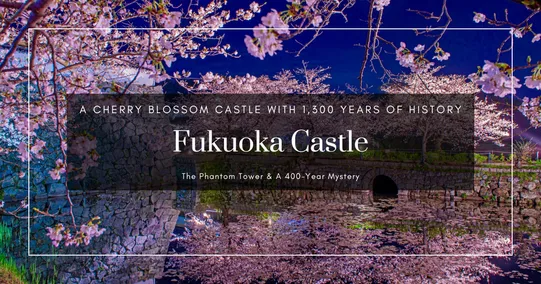
Additionally, Fukuoka Castle hosts a cherry blossom festival in spring, with about 1,000 cherry trees in full bloom. Visiting during cherry blossom season is highly recommended.
Experience historic turrets, restored structures, and sweeping views from the tower base. Come explore Fukuoka Castle for yourself.