Odawara Castle Guide: Wear Samurai Armor and Try Ninja Skills at This Legendary Fortress

Contents
The Final Stage of Japan’s Unification: Highlights of Odawara Castle
The Siege of Odawara brought the Sengoku period to an end. Odawara Castle was the stage where it all happened.
Today, the castle grounds house museums, hands-on samurai and ninja experience facilities, and an impressive series of castle gates along the main route. There is plenty to see and do.
This article introduces the highlights of Odawara Castle.
Odawara Castle

Odawara Castle is a renowned Sengoku-period fortress located in the city of Odawara, Kanagawa Prefecture. It served as the stronghold of the Hojo clan for five generations over approximately 100 years, withstanding attacks from powerful warlords such as Uesugi Kenshin, Takeda Shingen, and Toyotomi Hideyoshi. It earned the reputation of being an impregnable castle.
Today, the site has been developed as Odawara Castle Park, a popular tourist destination that combines history and hands-on experiences, including the Castle Tower Museum, NINJA Hall, and SAMURAI Hall.
| Item | Details |
|---|---|
| Cultural Designation | National Historic Site / One of Japan 100 Famous Castles (No.23) |
| Castle Stamp | Available at the castle tower ticket counter (2 standard versions) |
| Castle Tower Hours | 9:00 am - 5:00 pm (last entry at 4:30 pm) |
| Castle Tower Admission | Adults ¥1,000 / Elementary and junior high school students ¥300 |
| SAMURAI Hall Hours | 9:00 am - 5:00 pm (last entry at 4:45 pm) |
| SAMURAI Hall Admission | Included with castle tower ticket (standalone: Adults ¥300 / Elementary and junior high school students ¥100) |
| NINJA Hall Hours | 9:00 am - 5:00 pm (last entry at 4:30 pm) |
| NINJA Hall Admission | Adults ¥500 / Elementary and junior high school students ¥200 |
| Closed | Castle Tower: 2nd Wednesday of December, Dec 31 - Jan 1 / NINJA Hall and SAMURAI Hall: Dec 31 - Jan 1 |
| Wi - Fi | Free Wi - Fi available at the castle tower, Tokiwagi - mon Gate, NINJA Hall, Honmaru shop, and Ninomaru Tourist Information Center |
| Nearest Station | JR Odawara Station (approx. 10 - minute walk) |
| Parking | No parking within the castle park (List of nearby parking) |
| Address | 250 - 0014 Jonai, Odawara, Kanagawa |
| Official Website | Odawara Castle Official Website |
| Facility Pamphlets | Visitor Guide - Pamphlets | Odawara Castle Official Website |
Castle Tower Museum: Exhibition Space of Exceptional Quality

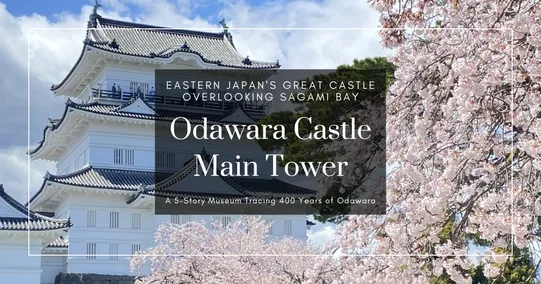
The castle tower of Odawara Castle was reconstructed in 1960 based on Edo-period architectural plans. The three-tiered, four-story structure stands 38.7 meters tall. While the exterior faithfully reproduces the Edo-period appearance, the interior has been developed as a full-scale museum for historical artifacts and exhibits.

The tower has five floors, each dedicated to a different theme. The first floor covers Odawara Castle during the Edo period, the second floor focuses on the Sengoku period and the Hojo clan, the third floor displays arts and crafts associated with Odawara, the fourth floor hosts special exhibitions, and the fifth floor features a recreated space dedicated to the Marishiten deity. In addition, the top floor (5th floor) features an observation deck where visitors can enjoy a spectacular panoramic view of Sagami Bay.

Read more about Odawara Castle Tower
SAMURAI Hall: An Exhibition of the Beauty and Power of Samurai Arms and Armor

The SAMURAI Hall, located at Tokiwagi-mon Gate, is an exhibition facility dedicated to samurai weaponry and armor. If you have a castle tower admission ticket, you can enter the SAMURAI Hall at no additional cost. A standalone ticket is also available (¥300 for adults, ¥100 for elementary and junior high school students).
The hall displays precious arms and armor, including suits of samurai armor and Japanese swords, rarely seen in everyday life.

The rows of armor are strikingly imposing and impressive even just to look at. The projection mapping show “Hana Kutsu Yoroi” brings the world of the samurai to life through digital imagery and music.

The SAMURAI Hall also offers a samurai armor fitting experience. Available on the first floor of Tokiwagi-mon Gate from 9:30 to 16:00, the rental fee is ¥500. Put on a suit of armor and become a samurai yourself.
Read more about SAMURAI Hall

NINJA Hall: A Hands-On Facility to Experience the World of Fuma Ninja

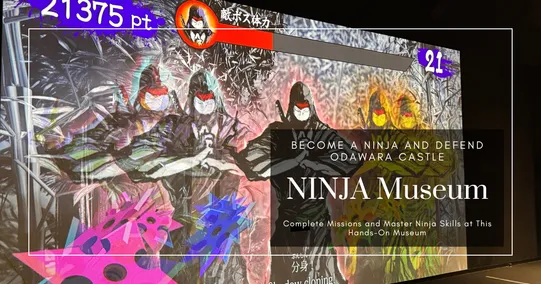
The NINJA Hall is a facility where you can truly experience being a ninja through training and practice. Try out the various devices and ninjutsu techniques throughout the hall, and immerse yourself in the world of ninja through hands-on, full-body activities.
Read more about NINJA Hall
Honmaru Square: Photo Ops with Samurai and Shuriken Throwing

In front of the castle tower lies Honmaru Square. Here, you can rest on benches, and purchase drinks, food, and souvenirs at the shop.
Samurai in full armor are stationed at Honmaru Square, and you can take photos with them.


The matchlock gun squad also regularly performs blank-firing demonstrations. The thunderous sound is truly impressive and worth witnessing.

Food stalls offer refreshments, and you can also try throwing shuriken (ninja stars). It is the perfect spot to take a break while admiring the castle tower.
Umadashi-mon Gate: The Main Entrance of Odawara Castle

Umadashi-mon is the main entrance gate located on the southeast side of Odawara Castle. Situated past the Megane-bashi Bridge, it marks the starting point of the official climbing route to the castle tower.

Beyond the gate lies an open area called Umaya Kuruwa (the horse stable enclosure).

Akagane-mon Gate: The Main Gate of Ninomaru with Interior Tours
Akagane-mon is the main gate of the Ninomaru (second bailey), located beyond Umadashi-mon. The name comes from the copper plate decorations on the Watari-yagura gate tower. Inside, defensive features such as stone-dropping chutes remain intact.


On weekends and holidays, visitors can enter the interior of Akagane-mon. (10:00 - 15:00)
Inside, you can see the actual stone-dropping chutes up close, as well as an exhibit recreating the scene of the Odawara Hyojo, a war council held by the Hojo clan.


The Odawara Hyojo refers to the repeated war councils held among senior retainers during the Siege of Odawara, when Toyotomi forces were at the gates, debating whether to resist or surrender. The exhibit recreates a scene of Hojo Ujimasa, Ujinao, Ujiteru, and two senior retainers in discussion.

Opinions were divided, and ultimately no conclusion was reached. The Hojo clan was destroyed.

Tokiwagi-mon Gate: The Main Gate to the Honmaru
Tokiwagi-mon is the main gate to the Honmaru (inner bailey), located beyond Akagane-mon. Its Watari-yagura gate tower is one of the largest in the castle, and the Tamon-yagura turret served as a storehouse for weapons and supplies.

Tokiwagi means evergreen tree. Pine trees have been planted near this gate since ancient times, and the gate was named with the wish that the castle would prosper endlessly, just as pine trees stay green throughout the year.

Official Climbing Route: The Path from Umadashi-mon to the Castle Tower
The official route through Odawara Castle follows the path: Umadashi-mon Gate, Akagane-mon Gate, Tokiwagi-mon Gate, Honmaru Square, and then the Castle Tower.
Passing through Umadashi-mon Gate and crossing the Umaya Kuruwa plaza, you reach Akagane-mon, the main gate of the Ninomaru. Beyond Akagane-mon lies the Ninomaru area, and continuing on, you arrive at Tokiwagi-mon Gate. Once through Tokiwagi-mon, you emerge onto Honmaru Square, where the castle tower stands.
Ninomaru Tourist Information Center: Sign Up for Free Guided Tours Here
At the Ninomaru Tourist Information Center, located in the Umaya Kuruwa plaza, you can sign up for a guided tour covering the history and highlights of Odawara Castle.

Simply visit on the day, and you can sign up for a free guided tour. (9:00 - 16:30)
The building has a historical exterior and is equipped with restrooms.
How to Get to Odawara Castle
Umadashi-mon Gate, the main entrance of Odawara Castle, is approximately a 10-minute walk from JR Odawara Station.
On weekends and holidays (excluding the year-end and New Year period), you can also get there by the Umemaru - go sightseeing bus operated by Odawara City. A one-day pass (¥600) allows unlimited rides. An onboard guide provides tourist commentary during the trip.
If boarding the Umemaru-go from Odawara Station, get off at the Megane-bashi bus stop (travel time: approx. 3 minutes). The bus stop is right in front of Umadashi-mon Gate, so you can join the official climbing route directly.
From Odawara Castle to Odawara Station
If you want to return to Odawara Station after exploring Odawara Castle, you do not need to take a bus. You can simply walk.
Head from the castle tower toward the north exit. Once you leave through the north exit, Odawara Station is right there.

History of Odawara Castle

The origins of Odawara Castle date back to the Muromachi period. Its predecessor was a fortification built by the Omori clan, who had expanded their influence into western Sagami. The exact year of construction is unknown, but it is estimated to be around the mid-15th century.
Around 1500, Ise Sozui (later known as Hojo Soun) seized Odawara Castle from the Omori clan. From then on, the Hojo clan expanded their power from Odawara, ruling over the Kanto region for five generations spanning approximately 100 years.
In the Edo period, Okubo Tadayo, a hereditary vassal of Tokugawa Ieyasu, became the first castle lord, and Odawara Castle served as the administrative seat of the Odawara Domain. The Okubo clan was temporarily dismissed but later reinstated, and they served as domain lords until the end of the Edo period.
In 1870, Odawara Castle was decommissioned under the castle abolishment decree, and most of its buildings were demolished. The Great Kanto Earthquake of 1923 further destroyed the remaining stone walls. The current castle tower was reconstructed in 1960 as a reinforced concrete structure to mark the 20th anniversary of Odawara gaining city status. The castle site is designated as a National Historic Site.
| The Omori clan builds Odawara Castle | |
| Hojo Soun (Ise Sozui) seizes the castle from the Omori clan | |
| Third-generation lord Hojo Ujiyasu inherits leadership and strengthens domain control | |
| Defeats the Uesugi clan at the Battle of Kawagoe, establishing Hojo dominance over the Kanto region | |
| Fourth-generation lord Hojo Ujimasa inherits leadership | |
| Repels an attack by Uesugi Kenshin | |
| Repels an attack by Takeda Shingen | |
| Constructs the Sogamae outer defense perimeter stretching approximately 9 km | |
| The Hojo clan falls in the Siege of Odawara. Okubo Tadayo becomes castle lord | |
| Castle decommissioned under the abolishment decree | |
| Stone walls destroyed in the Great Kanto Earthquake | |
| Castle tower reconstructed in reinforced concrete |
The Hojo Clan and the Golden Age of Odawara Castle
Hojo Ujiyasu, the third-generation lord, inherited leadership in 1541 and established a robust system of domain governance. In 1546, at the Battle of Kawagoe, he defeated the Uesugi clan and secured Hojo dominance over the Kanto region.
During the era of his successor, fourth-generation lord Hojo Ujimasa, Uesugi Kenshin attacked Odawara Castle with a massive army in 1561, and Takeda Shingen did the same in 1569. Both were repelled.
Then, in preparation for a decisive battle against Toyotomi Hideyoshi, Ujimasa and fifth-generation lord Ujinao constructed the Sogamae beginning in 1589. This massive outer defense perimeter, stretching approximately 9 km from Mount Hachiman to the coast, enclosed the entire town of Odawara with earthen walls and dry moats. It transformed Odawara Castle into one of the largest castle complexes in Japan.
Why Odawara Castle Was Called Impregnable
Odawara Castle earned its reputation as an impregnable fortress due to a combination of factors.
The Sogamae Outer Defense Perimeter


The Sogamae of Odawara Castle
The Sogamae, stretching approximately 9 km in total length, was a massive outer defense perimeter that enclosed the entire castle town with earthen walls and dry moats. This vast defensive line blocked enemy infiltration and wore down attacking forces.
- Odawara Castle Sogamae Map [PDF]
- Explore the Sogamae for the First Time | Tour Courses | Little Trip Odawara [Odawara Tourism Association]
Natural Terrain Advantage

Odawara Castle was built on a hilly terrain facing Sagami Bay. With the sea to the east and mountains to the west, the natural landscape served as a natural fortress.
Structural Strength of the Castle
Numerous turrets and gates were strategically placed throughout the castle complex, designed to prevent enemy penetration. Furthermore, ample food and water supplies were stockpiled, enabling the castle to withstand prolonged sieges.
A Proven Track Record Against Formidable Opponents
Renowned Sengoku warlords such as Uesugi Kenshin and Takeda Shingen attacked with massive armies, but none could capture Odawara Castle. These victories cemented the castle’s reputation as impregnable.
The Siege of Odawara: The Hojo Clan’s Final Battle

The Siege of Odawara, also known as the Battle of Odawara or the Odawara Campaign, was the most significant event in the history of Odawara Castle.
In 1588, Toyotomi Hideyoshi had issued the Sobuji-rei, an edict prohibiting private warfare among feudal lords. Violators faced severe punishment: military subjugation by Hideyoshi’s forces and confiscation of their domains.
The Hojo clan outwardly showed submission to Hideyoshi but continued to act as an independent power. Then, in October 1589, Hojo retainer Inomata Norinage seized Nagurumi Castle in Kozuke Province from the Sanada clan. Hideyoshi deemed this a violation of the Sobuji-rei and resolved to subjugate the Hojo clan.
In March 1590, Hideyoshi marched with feudal lords from across the nation. By April, an army of approximately 180,000 troops surrounded Odawara Castle. The Hojo clan mounted a siege defense with about 50,000 soldiers, but during the Odawara Hyojo war councils, opinions remained divided on whether to resist or surrender. After approximately 100 days of siege, the castle surrendered in July.
The Siege of Odawara brought about the fall of the Hojo clan and completed Hideyoshi’s unification of Japan.
See, Touch, and Experience History at the Castle That Marked the End of the Sengoku Era
This castle served as the stage where the Sengoku period came to its end. Today, it has been developed as a tourist destination filled with highlights throughout the entire grounds, from historical exhibits to samurai and ninja cultural experiences and tours of the castle gates.
You can trace history in detail at the castle tower museum, or explore the gates along the official climbing route to understand their defensive ingenuity. On weekends and holidays, you can even tour the interior of Akagane-mon Gate for a deeper understanding of Odawara Castle.
See with your own eyes, touch with your own hands, and feel with your whole body the history of the castle that once determined the fate of a nation.
Odawara Castle awaits with a wealth of experiences. It is well worth a visit.

