Kofu Castle Guide: Towering Stone Walls and Mt. Fuji Views in Yamanashi

Contents
Towering Stone Walls and Breathtaking Panoramas: A Complete Guide to Kofu Castle
Kofu Castle in Yamanashi Prefecture features stone walls so tall they make your neck ache just looking up. From the tower base, you can enjoy a sweeping panorama of Mt. Fuji and the Kofu Basin. Despite being just a short walk from the station, this castle delivers truly impressive scenery.
This article covers everything worth seeing at Kofu Castle, from stone walls and restored structures to scenic views, cherry blossoms, night views, and history.
Kofu Castle (Maizuru Castle Park)

Kofu Castle is a castle ruin located in Kofu City, Yamanashi Prefecture. Today it is maintained as Maizuru Castle Park. Its alternate name is Maizuru Castle, named after the appearance of the white-walled castle spreading out like a crane with its wings extended.
| Item | Details |
|---|---|
| Name | Kofu Castle Ruins (Maizuru Castle Park) |
| Hours | Park open 24 hours Inari Turret and Kurogane Gate: 9:00 am - 4:30 pm Yamate Gate: 9:00 am - 5:00 pm |
| Closed | Inari Turret, Kurogane Gate, Yamate Gate: Mondays (open on holidays) / Day after holidays / Year - end and New Year |
| Admission | Free |
| Access | 5 - minute walk from JR Kofu Station South Exit (Yamate Gate is 1 - minute walk from North Exit) |
| Address | 1 - 5-4 Marunouchi, Kofu City, Yamanashi Prefecture |
The Signature of Kofu Castle: Towering Walls of Irregular Boulders
The most impressive feature of Kofu Castle is the powerful stone walls that surround the entire castle. Built about 400 years ago, these walls remain in their original form.

The tallest stone walls exceed 14 meters, equivalent to a five-story building. Looking up, you will be overwhelmed by the sight of irregular boulders rising toward the sky.

These walls were built using a technique called nozurazumi (rough stone stacking). Natural stones were stacked with minimal processing, and smaller stones were packed into the gaps between larger ones. Unlike neatly arranged stone walls, these feature massive irregular boulders dramatically piled together.

Looking closely at the walls, you can find square holes arranged in rows on the stone surfaces.

These are called yaana (wedge holes). These holes were made to split large boulders, with wedges driven into them to break the stone apart.
The work of stonemasons from 400 years ago remains carved into these walls. While the powerful stone walls create an impressive scene, you can also glimpse the delicate craftsmanship of these artisans.

Restoration Progresses: Historic Structures Preserving the Past
Several lost structures have been restored at Kofu Castle. The gates and turrets rebuilt using period techniques are valuable assets that convey the history of the castle.
Kurogane Gate (Iron Gate)

Kurogane Gate is a two-story turret gate located at the boundary between the main bailey and the tower bailey. It was restored in 2013.
The name comes from the iron plates covering the gate doors. Covered with iron plates about 1 cm thick, the gate was built to withstand musket fire. It symbolizes the defensive capabilities of the castle.

Inari Turret

The Inari Turret on the eastern side of the Inari Bailey is a two-story turret. The interior is open as an exhibition facility where you can see gold-leafed shachihoko roof tiles and other artifacts from excavations, as well as a diorama model of Kofu Castle. Admission is free.

Kajikuruwa Gate and Inarikuruwa Gate
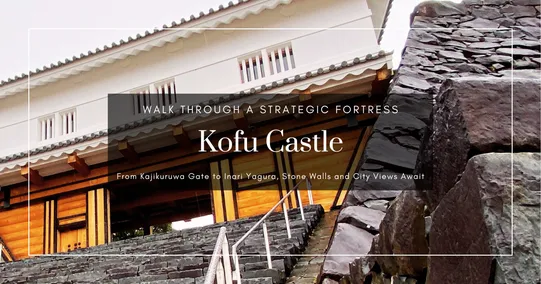
Kajikuruwa Gate is located on the southwest side of the main bailey and was restored in 1997. It is a yakuimon-style gate featuring a gabled roof and a small side door.

Inarikuruwa Gate was restored in 1999. As a gate connecting two baileys, it preserves the appearance of the original structure.

Yamate Gate
Yamate Gate was one of three entrances on the north side of Kofu Castle. It was restored in 2007.

Although separated from Maizuru Castle Park by the JR Chuo Main Line tracks, it has been developed as Kofu City History Park, adjacent to Koshu Yumekoji, a 5-minute walk from Kofu Station North Exit. It consists of two gates, the Korai Gate (Yamate Gate) and the turret gate (Yamate Watariyagura Gate), and you can view exhibits about Kofu Castle history inside the turret gate.

Mt. Fuji and Kofu Basin Views from the Tower Base
The main tower of Kofu Castle no longer exists, but you can climb to the tower base. The view from here is one of the greatest attractions of Kofu Castle.

From the tower base, you can enjoy a 360-degree view of the Kofu Basin. To the west, snow-capped peaks of the Southern Alps stretch across the horizon. To the north, the city center around Kofu Station spreads out below.

Looking south, Mt. Fuji rises beyond the cityscape of the Kofu Basin. On clear days, the snow-covered peak of Mt. Fuji stands out sharply. This view has been recognized as one of the 100 Views of Mt. Fuji from the Kanto Region.


When you visit Kofu Castle, be sure to climb the tower base and experience this panoramic view.
About 160 Cherry Trees Adorning the Stone Walls
Kofu Castle is also known as a cherry blossom viewing spot. About 160 cherry trees are planted within the castle grounds, and in spring they bloom magnificently along the stone walls.


The best viewing period is typically from mid-March to early April. The scene of rough stone walls, white walls, and soft pink cherry blossoms is a special sight unique to this season.

A Dry Landscape Japanese Garden Within the Castle

On the south side of Kofu Castle, a Japanese garden has been developed in the Kajikuruwa area. Created in 1993 in the karesansui (dry landscape) style, the garden features a dry stream of white sand at its center, surrounded by well-maintained greenery.

At the upstream end of the dry stream, a small dry waterfall rock arrangement has been placed, evoking the former inner moat and nearby rivers. This quiet garden showcases the contrast of white sand and green within a space enclosed by stone walls and white plaster.

If you enter through Kajikuruwa Gate or Yukibashi Bridge, you can walk through this Japanese garden on your way to the main bailey.
Open 24 Hours: Night Views from the Tower Base

Maizuru Castle Park is open 24 hours, allowing you to climb the tower base even at night. This is a spot where you can enjoy Kofu Castle in a completely different atmosphere from daytime.

Below, the white-walled Inari Turret is beautifully illuminated. Beyond it, the night view of Kofu unfolds with building lights and street lamps. The historic castle and modern cityscape blend together in this nighttime spectacle.


History of Kofu Castle: A Strategic Stronghold Built by Toyotomi Hideyoshi

Kofu Castle was built after the fall of the Takeda clan in 1582.
In the 1590s, construction began under orders from Toyotomi Hideyoshi, who had unified Japan. The purpose was to keep Tokugawa Ieyasu, who held territory in the Kanto region, in check. Kai Province was a strategic point connecting the Tokaido and Nakasendo highways, making it an important military location.
Construction was overseen by Asano Nagamasa and his son Yukimasa, retainers of Hideyoshi. The castle is believed to have been completed around 1600.
After the Battle of Sekigahara in 1600, Kofu Castle became a Tokugawa castle. Kofu remained an important stronghold for the Edo shogunate, with castle lords closely connected to the shogunal family. In 1705, Yanagisawa Yoshiyasu, a chamberlain to the fifth shogun Tokugawa Tsunayoshi, became castle lord.
During the Meiji era, the buildings within the castle were demolished, but the stone walls survived and remain to this day. In 2019, it was designated a National Historic Site.
| Fall of the Takeda clan. Kai Province comes under Toyotomi Hideyoshi control | |
| Construction begins under Hideyoshi orders. Asano Nagamasa and Yukimasa oversee the work | |
| Kofu Castle completed | |
| After the Battle of Sekigahara, becomes a Tokugawa castle | |
| Yanagisawa Yoshiyasu becomes castle lord | |
| Castle buildings demolished. Stone walls remain | |
| Designated a National Historic Site |
Stone Walls Underground at the Prefectural Office: The Relocated Inner Moat Walls
The Yamanashi Prefectural Office is a 5-minute walk from Kofu Castle. In 2010, during construction of a new facility next to the prefectural office, stone walls from Kofu Castle inner moat were discovered.
Today, the excavated inner moat stone walls have been relocated and restored in the basement level of the new building, the Yamanashi Prefectural Government Disaster Prevention Building, and are open to the public free of charge as the Kofu Castle Stone Wall Exhibition Room.

Read more about the Kofu Castle Stone Wall Exhibition Room

Which Entrance? Kofu Castle Has Five Entry Points
Choosing an entrance can be confusing on your first visit. Kofu Castle has five entrances, each with its own characteristics. Choose based on your purpose and mobility needs.

- Maizuru Castle Park Entrance
The closest entrance from JR Kofu Station. It leads through the Inari Bailey with the Inari Turret to the main bailey where the tower base is located. This route has no stairs, only slopes, making it easy for families with strollers. The slopes are moderately steep, so wheelchair users will need assistance. - Hydrangea Plaza Entrance
This entrance is located beside the Hydrangea Plaza at the northeast corner of Kofu Castle. Except for the initial stairs, the entire route consists of slopes, also leading through the Inari Bailey to the main bailey. Convenient when coming to Kofu Castle from Koshu Yumekoji. - Uchimatsukage Gate
This is also one of the closest entrances from JR Kofu Station. Unlike the Maizuru Castle Park Entrance, this route uses stairs to climb directly to the main bailey. Convenient if you want to reach the main bailey by the shortest route. - Kajikuruwa Gate
This entrance is at the southwest corner of Kofu Castle. It is the longest route to the main bailey and tower base, with both slopes and stairs. - Yukibashi Bridge
An entrance on the south side of Kofu Castle. Cross the Yukibashi Bridge to enter the castle. Convenient when coming from Koedo Kofu Hanakoji.
Recommended Walking Route: From Kajikuruwa Gate to the Main Bailey
For the most complete experience of Kofu Castle highlights, the route from Kajikuruwa Gate is recommended.

This route passes through Kajikuruwa Gate, the Japanese garden, and Kurogane Gate before reaching the main bailey, allowing you to enjoy the most highlights of Kofu Castle.
The walking time is about 40 minutes. For details, see the article below.
400 Years of History and Massive Stones: A Great Castle of Kai Province

Powerful stone walls. Panoramic views of Mt. Fuji and the Kofu Basin from the tower base. The craftsmanship of stonemasons preserved from the time of construction. Kofu Castle is filled with attractions.
In spring, about 160 cherry trees color the stone walls. At night, enjoy the combination of city lights and illuminated castle structures. This castle ruin shows different faces by day and night.
Stone walls that have stood for about 400 years continue to watch over the city of Kofu.
Come see for yourself the massive stones stacked by stonemasons 400 years ago.
