- Miyazaki
- Nichinan City
- Tourism
- Preservation Districts for Groups of Traditional Buildings
- Michelin Green Guide Japan
- Japan Heritage
Is Obi Castle Town's Food Walk Ticket Worth It? A Cost Breakdown

Contents
Exploring Obi Castle Town with the Ayumi-chan Map! A Value Breakdown

In Obi Castle Town in Nichinan City, Miyazaki Prefecture, there is a year-round food walk plan called the "Ayumi - chan Map" that lets you explore the castle town while enjoying local treats.
This ticket package includes a pass and 5 exchange coupons—but is it really worth it? We purchased one and walked through the castle town to find out.
For a guide to the highlights of Obi Castle Town, see the article below.
Read more about highlights of Obi Castle Town
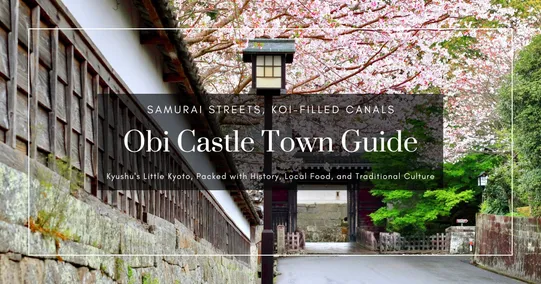
Starting from the Obi Tourist Parking Lot
The starting point for exploring Obi Castle Town is the Obi Tourist Parking Lot. You can purchase the Ayumi-chan Map at the information center next to the parking lot.

What is the Ayumi-chan Map?
The Ayumi-chan Map is a sightseeing map you receive when you purchase the “Obi Castle Town Food Walk & Town Walk Ticket.”

The ticket comes with 5 exchange coupons that can be redeemed at participating shops for local specialties like Obi-ten and thick rolled omelet.

Here are the pricing plans:
| Plan | Adult | High School/College | Elementary/Middle School |
|---|---|---|---|
| Food Walk + 2 Facility Admission | ¥1,000 | ¥1,000 | ¥1,000 |
| Food Walk + 6 Facility Admission | ¥1,600 | ¥1,400 | ¥1,150 |
*All plans include 5 exchange coupons
At the information center, you can also get a leaflet about Obi Castle. It is packed with information about Obi Castle Town, so be sure to pick one up even if you do not purchase a combo ticket or Ayumi-chan Map.


Once you have your Ayumi-chan Map, the food walk begins!


Enjoying Obi Specialties at Obi-ten “Kura”
“Kura,” located at the entrance of the parking lot, is a specialty shop for Obi-ten. Obi-ten is a local dish made by frying a mixture of fish paste, tofu, brown sugar, and miso.


Inside, you can dine and buy Obi-ten, local sake, and side dishes.


Freshly made Obi-ten are lined up. Each costs 250 yen, but you can get one for free with an exchange coupon.


It has a fluffy texture and slightly sweet flavor.

There are benches outside the shop where you can sit and enjoy your food walk snacks.

This building was constructed in the Edo period and is the only remaining structure from the Obi castle town. Originally, it housed the Obi Domain office called “Obi Shosha.” The ceiling and pillars on the second floor remain from that era and can be viewed freely.

Running total: 250 yen (1 Obi-ten)
Exploring Obi Castle
It is about a 2-minute walk from the parking lot to Obi Castle.
At Obi Castle, you can walk through the “Shiawase Sugi” (Happiness Cedar Trees), which was a filming location for the NHK drama “Wakaba,” and the mystical former main keep area covered in moss and Obi cedar.
Here, we used the pass from the Ayumi-chan Map to enter Matsuo-no-Maru (usually 300 yen) and the Historical Museum (usually 300 yen).
For more details about Obi Castle, see the article below.
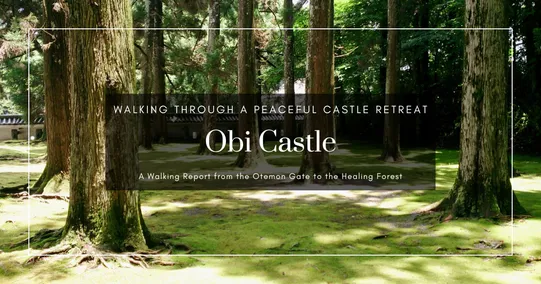
Running total: 850 yen (Obi-ten 250 yen + Matsuo-no-Maru 300 yen + Historical Museum 300 yen)
Into the Castle Town
After leaving Obi Castle, we headed into the castle town.

Crossing the Otecho intersection reveals the Edo-period streetscape of the castle town.

Koi Swimming in the Waterways
In the castle town, there are waterways known as “Koi Swimming Spots.”


Peering into the waterway, you can see colorful koi swimming gracefully.


According to the Ayumi-chan Map, koi swim throughout approximately 100–150 meters of the waterway.

These koi were released in 1982 to revive the scenery of Obi as a former water town. This landscape has been preserved for over 40 years.
Mitarashi Dango at Gallery “Kodama”
Our second food walk stop was Gallery “Kodama,” a multipurpose space.

This café, set in a renovated old house, offers a calm atmosphere to enjoy tea.
Following the sign at the entrance, we went around to the back gate for food walk items.


At Kodama, you can exchange your coupon for “mitarashi dango” (sweet soy sauce glazed rice dumplings) or “thick rolled omelet.”


We chose the mitarashi dango.

There are benches at the back for resting, but the adjacent storehouse is also open as an eat-in space.


Inside, the storehouse has been beautifully renovated, with natural wood tables and chairs.

Enjoying mitarashi dango in a renovated storehouse within the atmosphere of an Edo-era castle town—a truly luxurious moment.


If purchased with cash, mitarashi dango costs 150 yen.
Running total: 1,000 yen
Walking Through the Castle Town Streets
Strolling through Obi Castle Town, you can see that while it retains traces of the Edo period, it remains a living town where people still reside.


Obi Castle Town is designated as an Important Preservation District for Groups of Traditional Buildings. To protect the historically and culturally valuable streetscape, residents have worked together to maintain the appearance while continuing their daily lives.
For more on the preservation history of Obi Castle Town, see the article below.
“Tomura Yaki Chicken” at Super Tomura
Walking through the castle town, we arrived at Super Tomura Obi Store.

Even local supermarkets have specialty items available with the exchange coupon. One such item is “Tomura Yaki Chicken.”
Made by deep-frying chicken breast and coating it with sauce, you can find it in the deli section.

We exchanged our coupon at the register.

With its sweet flavoring, it was a welcome treat for tired legs.

The food walk version of Tomura Yaki Chicken is made in an easy-to-eat stick style. If purchased with cash, “Sasami no Tomura-yaki” costs 198 yen.
Running total: 1,198 yen
At this point, we still had room within the Food Walk + 6 Facility Admission ticket price of 1,600 yen. With 2 more items to exchange, the value became increasingly clear.
Archery Experience at the Shihanteki Range
At the Obi Tourist Parking Lot, there is a “Shihanteki Range.”


Shihanteki is a traditional half-bow archery that was practiced as entertainment at banquets among samurai in Southern Kyushu. It is designated as an Intangible Folk Cultural Property of Nichinan City.
Although we could not try it this time due to time constraints, the facility was bustling with activity. Opportunities to draw a bow are rare even in Japan, so give it a try if you can.
“Jutaro-maki” at Takei Confectionery
Near the parking lot, there is also a stall from Takei Confectionery.


We exchanged our coupon for a “Jutaro-maki.”

Jutaro-maki is not sold individually; if purchased with cash, a box of 6 costs 650 yen (about 108 yen each).

Running total: 1,306 yen
“Obi Castle Historical Timeline” at the Information Center
Exchange coupons are not just for food. At the information center, you can also exchange them for the “Obi Castle Historical Timeline.”

This timeline is also available for purchase online for 400 yen.
After exchanging all 5 items, the total value came to 1,706 yen.
Compared to the 1,600 yen ticket price, we saved 106 yen on our castle town exploration. Since we visited 2 facilities this time, the Food Walk + 2 Facility Admission Ayumi-chan Map (1,000 yen) would have saved us 600 yen.
Moreover, we still had admission rights remaining for 4 more facilities (Yosho-kan, Komura Jutaro Memorial Hall, Former Yamamoto Inohei House, and Merchant House Museum). Visiting all of these would add another 1,200 yen in value (300 yen × 4 facilities), bringing the total to 2,906 yen—a savings of 1,306 yen.
Enjoying Obi Castle Town at Great Value
Using the Ayumi-chan Map, you can enjoy a great-value food walk and easily navigate your sightseeing with the map in hand.
Our visit lasted about 2 hours, but there are still facilities we did not visit, like the Komura Jutaro Memorial Hall. Spending half a day to a full day would allow you to visit more facilities and get even more value.

Obi Castle Town has its highlights compactly arranged, making it easy to walk to most spots even when arriving by public transportation. The renovated old house cafés are stylish, the local specialties are delicious, and we were touched by the warmth of the Obi people.
When visiting Miyazaki Prefecture, be sure to stop by Obi Castle Town in Nichinan City.