- Miyazaki
- Nichinan City
- Tourism
- Shrine
- Nationally designated Places of Scenic Beauty
- Natural Monument
- Japan's Three Great Descending Shrines
Walking Through Udo Jingu Shrine: A Sacred Cave Sanctuary on Miyazaki's Seaside Cliffs

Contents
Experience the Mystique of Japanese Mythology and Breathtaking Scenery at Popular Udo Jingu Shrine
Udo Jingu Shrine in Nichinan City, Miyazaki Prefecture, is a highly unique shrine with its main hall nestled inside a cave carved into a sheer cliff, making it a popular tourist destination.
Beyond the main hall itself, this shrine is renowned for offering spectacular views throughout the entire grounds.
In this article, I’ll share my actual visit to Udo Jingu Shrine through plenty of photographs. I hope you can feel the atmosphere of this remarkable place.
For more about the highlights of Udo Jingu Shrine, please see the article below.
Read more about the highlights of Udo Jingu Shrine
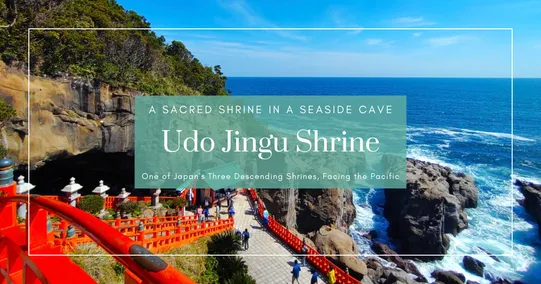
Walking the Approach to the Main Hall
The main approach starts from the amulet distribution office. From here, it’s about a 220-meter walk to the cave where the main hall is located.

Shortly after starting the walk, you’ll see the Shinmon, the first gate.


Passing through the Shinmon, the first breathtaking view opens up—the blue Pacific Ocean spreads out to your right. The contrast between the vermilion fence and the blue beyond is vivid and stunning.

On the opposite side, to your left, the shrine office comes into view.

Continuing further, the vermilion Romon gate appears. A Romon is a two-story gate without a roof over the first floor.

The vermilion Romon against the blue sky is so vibrant that you can’t help but look up in admiration.


The chrysanthemum crest on the gate doors indicates that Udo Jingu Shrine has connections to the imperial family.

After passing through the Romon, the atmosphere of the approach completely changes. With phoenix palm trees and the Pacific Ocean in view, you feel as if you’ve wandered into a tropical resort.


The blue ocean stretching to the horizon is truly dynamic.


From the approach, you can gaze at the endless Pacific horizon.


Although the approach is 220 meters long, there are rest areas along the way.

Eventually, as the approach nears its end, the temizuya (hand-washing basin) comes into view.

Just beyond is an Undama (luck stone) monument. At this point, you’ve nearly reached the end of the approach.


Cross the bridge ahead, and you’ll finally reach the cave where the main hall awaits.

From here, you descend stone steps to reach the cave. The “Kudari-miya” (descending shrine), where the main hall sits lower than the approach, is rare throughout Japan and is one of Udo Jingu Shrine’s defining features.


The stone steps can be slippery when wet, so please watch your step.

A Mystical Space Within the Cave
Look at this. The cave opens up along the cliff face. The main hall is inside. Even from outside, its presence is overwhelming.

The rock formations created by nature over countless years are awe-inspiring in their scale.

A torii gate stands at the entrance of the cave. Now it’s time to enter.

Upon entering the cave, the main hall immediately comes into view. The cave itself isn’t very deep.

The main hall is a designated cultural property of Miyazaki Prefecture. The current structure was rebuilt in 1711 by Ito Sukesane, lord of the Obi Domain. The Gongen-style, Yatsumune-zukuri (eight-gabled) building, tucked within the rock cave, has been repaired many times but still preserves its original appearance.
The main hall features intricate decorations, and although it’s a Shinto shrine, it’s said to incorporate Buddhist elements as well.


Looking outward from inside the cave, the light streaming through the gaps in the rock feels truly divine.


Now it’s time to pray in front of the main hall.


After praying, a path continues to the left. This is the worship route that circles around the main hall.

Exploring the Worship Path Behind the Main Hall
Following the path, a small shrine appears. This is Oji Shrine, dedicated to Hikoitsuse-no-Mikoto.

The sight of a small shrine standing alone inside the cave feels utterly otherworldly.

Further along, you’ll find a rabbit statue. Rubbing it is said to bring blessings for healing illness, good fortune, and success.


Going around to the back of the main hall, it becomes even darker. Proceed carefully.
Behind the main hall is the “Ochichi-iwa” (Breast Rock). This spot is connected to mythology and is believed to bring blessings for safe childbirth and child-rearing. Although it’s too dark for photos, I encourage you to see it in person.


After passing behind the main hall, the worship path comes to an end.

The vermilion main hall set within nature’s rock formations, the torii and stone lanterns glowing in the light from outside—the view from inside the cave truly deserves to be called divine.

The Plaza in Front of the Cave and Undama Throwing
Outside the cave, just before the entrance to the main hall, there’s a plaza. The view from here is not to be missed.


Looking down from the plaza, you can see the rough waves of the Pacific crashing against the rocks up close.


Among the rocks is a turtle-shaped formation called “Kame-iwa” (Turtle Rock). Here you can enjoy Undama throwing.

A rope circle is placed on the back of Turtle Rock. If you throw an Undama into this circle, your wish is said to come true. The rule is: men throw with their left hand, women with their right.

Undama can be purchased at the Undama distribution stand near the cave entrance. A set of 5 costs 200 yen, and they’re made from baked clay.

After Your Visit, Relax at the Cafe and Don’t Forget Souvenirs
After finishing your visit and walking back along the approach, you’ll find a cafe and souvenir shop near the amulet distribution office where you started.
The cafe is called “Rainforest Cafe Mitsuwaso Branch.” The interior is surprisingly stylish for being located on shrine grounds. Free Wi-Fi is available.


The souvenir shop is called “Hatchozaka Shoten.” The store is spacious and offers a wide variety of Miyazaki souvenirs.


About Parking
Udo Jingu Shrine has three parking areas, all free of charge. However, the distance to the approach entrance varies depending on the parking lot. I recommend deciding where to park before you visit.
For more details on parking, see the article below.
Udo Jingu Shrine: Wrapped in Mystery and Spectacular Views
Udo Jingu Shrine is a historically significant shrine that even appears in Japanese mythology.
The main hall inside the cave offers a mystical experience unlike anywhere else. And beyond the main hall, the entire grounds—from the ocean-view approach to the plaza on the cliffs—offer breathtaking scenery.
History, mystery, and nature. And the openness of a tropical resort. Udo Jingu Shrine is packed with so many elements—I highly encourage you to visit.
