- Miyazaki
- Nichinan City
- Tourism
- Japanese castle
- 100 famous castles in Japan
- Preservation Districts for Groups of Traditional Buildings
- Michelin Green Guide Japan
- Japan Heritage
Obi Castle Guide: A Miyazaki Castle Cloaked in Mystical Moss and Obi Cedar

Contents
A Castle That Survived 100 Years of Conflict: The Complete Guide to Obi Castle
Two powerful daimyo clans fought over a single castle for nearly 100 years. This castle with such a dramatic history stands in Nichinan City, Miyazaki Prefecture.
The Otemon Gate restored with Obi cedar, the massive masugata koguchi that confounded enemies, and the “Healing Forest” where 140-year-old cedar trees soar. We’ll introduce the highlights of this castle where the appeal of castle architecture and calming nature coexist.
Obi Castle

Obi Castle is a castle ruin located in Nichinan City, Miyazaki Prefecture. From 1588 (Tensho 16) until the Meiji Restoration, it flourished for about 280 years as the residence of the Ito clan with a domain of 51,000 koku. Selected as one of Japan’s Top 100 Castles, it attracts many visitors along with its castle town known as “Kyushu’s Little Kyoto.”
| Item | Details |
|---|---|
| Name | Obi Castle (Obi - jo) |
| Address | 10 - 1 Obi, Nichinan City, Miyazaki 889 - 2535 |
| Hours | 9:30 am AM - 4:30 am PM |
| Closed | Obi Castle Historic Facilities: December 29 - 31 |
| Admission | Castle ruins free. Combined ticket for History Museum and other facilities: Adults ¥800 |
| Official Site | https://obijyo.com/ |
Otemon Gate: The Castle’s Main Gate Revived with Obi Cedar

The Otemon Gate, the main entrance to Obi Castle, was restored in 1978 (Showa 53). The castle buildings demolished during the Meiji era were brought back to life using locally sourced Obi cedar.
This impressive yaguramon (turret gate) stands approximately 12 meters tall and 7 meters wide, featuring four Obi cedar trees that are about 100 years old. It was built using the traditional “kumishiki” joint construction method without any nails, and the roof features “hongawarabuki” style with alternating flat and round tiles.

The Otemon Gate’s charm lies in its dignified atmosphere created by the thick Obi cedar pillars that develop a richer patina over time and the traditional construction techniques that showcase them. When you visit Obi Castle, start by feeling the castle’s majesty at this Otemon Gate.

Masugata Koguchi: A Massive Defensive Space That Confounded Enemies
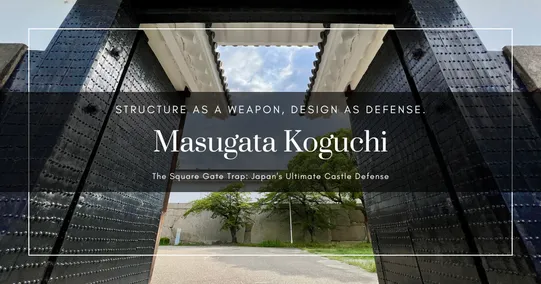
Passing through the Otemon Gate, you’ll find a wide, square-shaped space. This is the “masugata koguchi,” a defensive structure that Obi Castle takes pride in.

Obi Castle’s masugata koguchi is a massive space surrounded on all sides by earthen walls equipped with gun ports. When enemies entered this space, defenders could unleash attacks from three sides simultaneously.
Furthermore, at Obi Castle, there are sections that force not only 90-degree turns but also 180-degree reversals. Enemies had to come to a complete stop to proceed, all while being subjected to continuous attacks from the garrison.

Learn more about how masugata koguchi works and its structure at Obi Castle in the article below.
Read more about masugata koguchi
Former Main Bailey “Healing Forest”: Tranquility Woven by 140-Year-Old Cedars and Moss

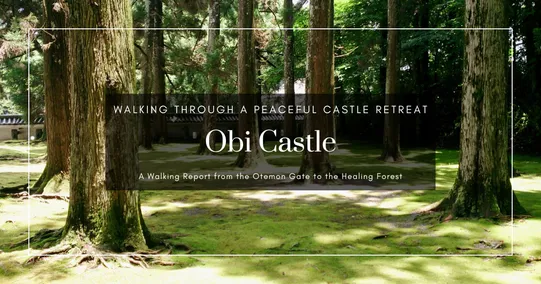
The former main bailey site is where the feudal lord’s palace once stood. Today, no buildings remain—instead, Obi cedars over 140 years old reach straight toward the sky, while the ground is covered with deep green moss.
Dappled sunlight filtering through the cedar grove and a carpet of moss spreading at your feet. Despite being the heart of the castle, this space enveloped in tranquility is called the “Healing Forest” and has become one of Obi Castle’s most popular spots.
Stand in the former main bailey, close your eyes, and you’ll hear the gentle whispers of the trees within the silence.
This forest, brimming with negative ions, is Obi Castle’s greatest highlight.

In the 2004 (Heisei 16) NHK morning drama “Wakaba,” this former main bailey and the north gate frequently appeared.
Shiawase Sugi: A Power Spot Created by Four Cedar Trees
In one corner of Obi Castle stand four cedar trees growing together. They came to be called “Shiawase Sugi” (Happiness Cedars) because “four trees coming together” sounds like “shiawase” (happiness) in Japanese.

A marker stone is placed at the center where the diagonal lines connecting the four cedars intersect, and it’s said that standing at this spot will bring you the power of happiness. When you visit Obi Castle, be sure to stand in the center and take a commemorative photo.

Matsuo no Maru: Experience Edo Period Palace Architecture
Matsuo no Maru is a shoin-style building restored in 1979 (Showa 54). It was recreated based on early Edo period residences of high-ranking samurai. The building generously uses 100-year-old Obi cedar as its construction material.

Inside the building are the reception room, tea room, sleeping quarters, bathhouse, kitchen, and storage, offering a glimpse into the lifestyle of that era.


A must-see at Matsuo no Maru is the “yudono,” an old-style steam bath. It was modeled after the bathroom in the National Treasure “Hiunkaku” at Nishi Honganji Temple in Kyoto—an extremely rare feature.

Obi Castle History Museum: Learn About the Ito Clan’s History from the Warring States Period

The Obi Castle History Museum reopened after renovation in March 2022 (Reiwa 4). Approximately 220 historical artifacts related to the Obi domain are on display.
The museum houses samurai armor belonging to the first lord Ito Suketaka and his retainers, swords by renowned swordsmiths like Inoue Shinkai, weapons, ancient documents, and clothing. There’s also a corner introducing Obi Castle and the Obi domain’s history through projection mapping and CG videos, plus hands-on sections where visitors can hold actual Japanese swords and matchlock guns—making it enjoyable even for those unfamiliar with history.


For more details about the interiors of Matsuo no Maru and the Obi Castle History Museum, see the article below.
History of Obi Castle: 100 Years of Conflict and 280 Years of Ito Clan Rule
Obi Castle was built by the Tsuchimochi clan during the Northern and Southern Courts period (around the 14th century). After that, a struggle for control lasting about 100 years unfolded between the Ito and Shimazu clans.
At the time, Obi possessed two ports—Aburatsu and Tonoura—and was an important trading hub with Ming China and the Ryukyu Kingdom. It was also a source of high-quality Obi cedar, making it a territory neither clan could afford to lose.
In 1587 (Tensho 15), Toyotomi Hideyoshi’s pacification of Kyushu ended the conflict. The following year, Ito Suketaka, who served Hideyoshi, became lord of Obi Castle. For the next 280 years, 14 generations of the Ito family governed this land.
During the Edo period, the castle suffered three major earthquakes and was forced to undergo large-scale renovations. Stone walls were built during this time, and Obi Castle was transformed into a castle with characteristics of both medieval cluster-style and early modern castle architecture.
After the Meiji Restoration, all castle buildings were demolished, but in the Showa era, the Otemon Gate and Matsuo no Maru were restored to their current form.

| Built by the Tsuchimochi clan | |
| Conflict between Ito and Shimazu clans begins | |
| Toyotomi Hideyoshi’s pacification of Kyushu | |
| Ito Suketaka becomes first lord of Obi domain | |
| Major renovations following three earthquakes | |
| Abolition of feudal domains | |
| All castle buildings demolished | |
| Otemon Gate restored | |
| Matsuo no Maru restored |
How to Get to Obi Castle
By car, it’s about 10 minutes from the Nichinan-Togo IC on the Higashi Kyushu Expressway, or 40-60 minutes from Miyazaki Airport. There’s a free “Obi Castle Tourist Parking Lot” right near the castle.

By train, it’s about a 20-minute walk from Obi Station on the JR Nichinan Line.
Bicycle rentals (¥500/day) are available at Obi Station, reducing travel time to about 7 minutes.
A Healing Power Spot Protected by Castle Defenses and Obi Cedar

Obi Castle was fought over by the Ito and Shimazu clans for 100 years, then protected by the Ito family for the next 280 years. Though the buildings were lost during the Meiji era, the stone walls and moats remain as they were, while the Otemon Gate and Matsuo no Maru have been revived using local Obi cedar.

The wisdom of defense preserved in the masugata koguchi, the tranquility of cedars and moss spreading across the former main bailey, and the artifacts connected to the feudal lords at the History Museum. At Obi Castle, the charm of castle architecture and healing nature coexist.
Take your time to explore, along with the castle town known as “Kyushu’s Little Kyoto.”
