- Miyazaki
- Nichinan City
- Tourism
- Japanese castle
- 100 famous castles in Japan
- Preservation Districts for Groups of Traditional Buildings
- Michelin Green Guide Japan
- Japan Heritage
Walking Through Obi Castle: A Peaceful Retreat Among Cedar Trees and Moss

Contents
A Walking Report of Obi Castle: A Quiet Healing Retreat with 500 Years of History
Obi Castle is located in Nichinan City, Miyazaki Prefecture. It is one of Japan’s Top 100 Castles, situated at the heart of a castle town known as “Kyushu’s Little Kyoto.”
In this article, I’ll share my experience walking through Obi Castle, following the route of my visit.
For more about Obi Castle’s highlights and history, see the article below.
Read more about Obi Castle highlights
Obi Tourist Parking Lot and Information Center
The free Obi Tourist Parking Lot is convenient for visiting Obi Castle. It holds about 140 cars. If you’re coming by bus, the “Obi Castle” bus stop is located within this parking lot.


Inside the parking lot is the “Obi Castle Town Information Center.” You can pick up Obi Castle leaflets and walking maps here, so be sure to stop by before heading to the castle.


Walking to the Otemon Gate
Leaving the parking lot, you can see the Otemon Gate of Obi Castle ahead. It’s a straight path, so there’s no worry about getting lost.

Along the way, you’ll find the Komura Jutaro Memorial Hall.

Otemon Gate
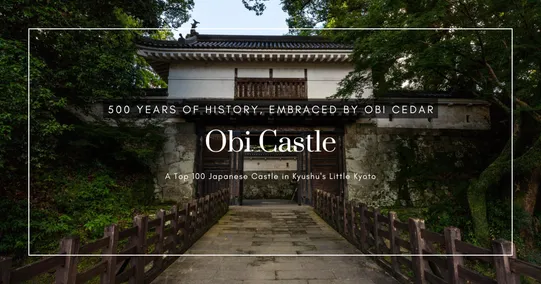
We’ve arrived at the Otemon Gate, the main entrance of Obi Castle.

This yaguramon (turret gate) was restored in 1978. Its moss-covered stone walls blending with the surrounding greenery create a striking impression.


You can observe the thick pillars and timber-frame construction up close.


Passing Through the Masugata Koguchi
Passing through the Otemon Gate, you enter a space enclosed on all sides by white plaster walls. This is the “masugata koguchi,” a defensive structure that Obi Castle takes pride in.

The masugata koguchi of Obi Castle forces multiple direction changes before reaching the main bailey, boasting one of the strongest defenses among Japanese castles.

Climbing the stone steps, you reach a stone wall where the path splits left and right.


Let’s proceed left, following the route.

A carpet of Obi cedar and moss spreads before you.


The stone steps are built low, making them easy to walk.


Shiawase Sugi and the Plaza
Exiting the masugata koguchi to the left, you’ll find the Shiawase Sugi (Happiness Cedars).

Legend says that standing at the center where the diagonal lines connecting the four corner cedars intersect will bring happiness.


Next to the Shiawase Sugi is a plaza with benches and restrooms.


From this plaza, Matsuo no Maru is to the left, the former main bailey site is straight ahead, and the History Museum is behind.
Matsuo no Maru
Heading west from the plaza, you’ll arrive at Matsuo no Maru.

This shoin-style building was restored in 1979, recreating an early Edo period residence of high-ranking samurai.


Inside the building are over 20 rooms including the reception room, tea room, sleeping quarters, bathhouse, kitchen, and storage.


The highlight is the yudono (bathhouse). This steam bath is modeled after the bathroom in the National Treasure “Hiunkaku” at Nishi Honganji Temple in Kyoto, showing how saunas worked in those days.


Water was boiled in a stove, and bathers sat on a slatted floor above it.


There are also samurai armor displays.

A model of the gozabune (ceremonial boat) used by the feudal lord for sankin-kotai (alternate attendance) is also on display.


Matsuo no Maru has many highlights and takes about 20-30 minutes to explore. Be sure to stop by.
Path to the Former Main Bailey Site
Returning to the plaza, we head toward the former main bailey site.

On the right, you can see the schoolyard of Obi Elementary School. This area was also once part of the main bailey. It’s unusual to have a school inside castle grounds.

We climb the stone steps lined with cedar trees.


The stone walls along these steps date from the early Edo period, with some sections remaining from the late Azuchi-Momoyama period.
Former Main Bailey Site “Healing Forest”
At the top of the stone steps, you arrive at the former main bailey site.

Obi cedars over 140 years old grow straight up, while the ground is covered with a carpet of moss. This is the most popular spot at Obi Castle.


The feudal lord’s palace once stood here, but it collapsed after three earthquakes in the late 1600s and was relocated to where Obi Elementary School now stands.
This space woven by cedar and moss is called the “Healing Forest,” where quiet time flows.


The former main bailey also has a yakuimon gate called “Toryumon” (Dragon Gate). This gate has an excellent atmosphere with its aged timber and surrounding mossy landscape.


From Toryumon, you can look down at the schoolyard of Obi Elementary School.

Obi Castle History Museum
Returning from the former main bailey, we head to the History Museum, which reopened in 2022 (Reiwa 4) after renovation.

The Obi Castle History Museum displays approximately 220 items related to the Obi domain, including samurai armor, swords, and ancient documents.

Armor and swords belonging to the first lord Ito Suketaka are on display.


There are also corners introducing Obi Castle’s history through projection mapping and CG videos.


There are hands-on exhibits where you can actually hold matchlock guns and swords.


The matchlock weighs 1,800g and the sword weighs 820g. They felt heavier than they looked. Few castles offer such hands-on experiences, so be sure to try holding them.

Obi Castle: Where Obi Cedar, Green Moss, and 500 Years of History Converge

What left the strongest impression walking through Obi Castle was the beauty of the moss-covered stone walls. The castle ruins, which have recorded over 500 years of history since the Northern and Southern Courts period, preserve time itself as part of the landscape.


There are no restaurants inside Obi Castle, so enjoying a meal in the castle town after your walk is recommended.
Enjoy a historical walk at Obi Castle and spend some quiet time surrounded by cedar trees and moss.
