- Miyazaki
- Nichinan City
- Tourism
- Preservation Districts for Groups of Traditional Buildings
- Michelin Green Guide Japan
- Japan Heritage
Obi Castle Town Guide: Kyushu's Little Kyoto with Koi-Filled Canals, Historic Streets, and Local Food Walks

Contents
Complete Guide to Obi Castle Town, Kyushu’s Little Kyoto
There’s a castle town in Nichinan City, Miyazaki Prefecture, known as “Kyushu’s Little Kyoto.”
Samurai residences surrounded by stone walls and hedges, merchant houses lined with latticed windows and wall lanterns, and koi swimming in the waterways. While walking through streets that preserve the atmosphere of the Edo period, you can also enjoy local food walks and traditional cultural experiences.
This article introduces the highlights of Obi Castle Town, including historical sites, townscape, gourmet food, and cultural experiences.
Obi Castle Town

Obi Castle Town is a historic castle town located in Nichinan City, Miyazaki Prefecture. For approximately 280 years from 1588 until the Meiji Restoration, it flourished as the castle town of the Ito clan, which held a domain worth 51,000 koku. In 1977, it became Kyushu’s first Important Preservation District for Groups of Traditional Buildings, and as “Kyushu’s Little Kyoto,” it attracts many visitors.
| Item | Details |
|---|---|
| Name | Obi Castle Town |
| Location | Obi, Nichinan City, Miyazaki Prefecture |
| Hours | Varies by facility (most open 9:30 am - 4:30 pm) |
| Closed | Varies by facility |
| Official Website | https://obijyo.com/ |
Layout of Obi Castle Town
First, let’s get an overview of Obi Castle Town.
Obi Castle Town is a compact castle town centered around Obi Castle. The Important Preservation District for Groups of Traditional Buildings covers approximately 19.8 hectares, and major spots can be explored on foot.
The castle town features a grid-like layout modeled after Heian-kyo (ancient Kyoto), with streets such as Otemon-dori, Ushiromachi-dori, Yokobaba-dori, and Honmachi-dori remaining. Samurai residences are concentrated in areas close to Obi Castle, while merchant houses gather along Honmachi-dori, farther from the castle.

- Obi Castle / Obi Castle History Museum
- Yoshokan
- Komura Jutaro Memorial Museum / Former Ito Sukemasa Residence
- Komura Jutaro Birthplace
- Former Yamamoto Ihei Residence
- Former Takahashi Genjiro Residence
- Merchant House Museum
- Former Domain School Shintokudo
Starting Point for Obi Castle Town Tourism: Ticket Office
The ticket office adjacent to Obi Castle Tourist Parking is the starting point for exploring Obi Castle Town.

Admission Tickets and Ayumi-chan Map
While strolling through Obi Castle Town itself is free, some facilities require admission fees.
In addition to individual tickets for each facility (300 yen), there’s a combined ticket (800 yen) that grants access to 6 facilities. Furthermore, the “Ayumi-chan Map” (1,600 yen) is also available, which includes the combined ticket plus 5 food vouchers for food walks.
If you want to enjoy food walks, the Ayumi-chan Map is recommended. Get your ticket here first, then start exploring the castle town.

Townscape of Obi Castle Town
Obi Castle Town features streetscapes that preserve the atmosphere of the Edo period. Streets near Obi Castle are lined with samurai residences surrounded by stone walls made of Obi stone and tea plant hedges, while Honmachi-dori is filled with merchant houses decorated with latticed windows, wall lanterns, and umbrellas.


Koi swim in the waterways running through the castle town. Released in 1982 to revive the landscape as a former water town, they are now one of the iconic sights of Obi Castle Town.

Restaurants and souvenir shops line the streets, allowing you to stroll while enjoying food walks. The shops are unified with castle town-style exteriors, showcasing the high level of completion of this Important Preservation District for Groups of Traditional Buildings.


Historical Spots in Obi Castle Town
Obi Castle Town offers many historical attractions where you can experience history, including castle ruins, samurai residences, memorial museums, and merchant houses. The main spots are as follows:
| Spot Name | Overview | Admission Fee |
|---|---|---|
| Obi Castle | One of Japan's 100 Famous Castles. A healing forest of moss and Obi cedar | Free (paid facilities separate) |
| Obi Castle History Museum | Displays about 220 artifacts related to the Obi Domain (inside Obi Castle) | Included in combined ticket |
| Matsuonomaru | Shoin - style palace reconstructed with Obi cedar (inside Obi Castle) | Included in combined ticket |
| Yoshokan | Highest - ranking samurai residence where the domain lord resided | Included in combined ticket |
| Komura Jutaro Memorial Museum | Honors the diplomat who concluded the Portsmouth Treaty | Included in combined ticket |
| Merchant House Museum | Oldest existing building in the Obi merchant district | Included in combined ticket |
| Former Yamamoto Ihei Residence | Main residence built by a Meiji - era wealthy merchant | Included in combined ticket |
| Former Domain School Shintokudo | Domain school that produced Komura Jutaro | Free |
| Komura Jutaro Birthplace | Site of Komura Jutaro's birthplace | Exterior only |
| Former Takahashi Genjiro Residence | Samurai residence registered as Tangible Cultural Property | Free |
Obi Castle

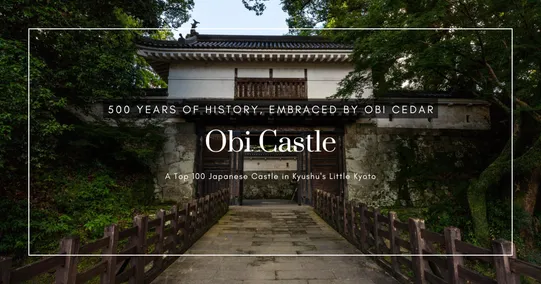
Obi Castle is the main highlight of Obi Castle Town. Selected as one of Japan’s 100 Famous Castles, the former main keep site features a “healing forest” with Obi cedars over 140 years old and a carpet of moss.
There are many attractions, including the main gate reconstructed with Obi cedar, a massive masugata (square gateway) designed to confuse enemies, and the “Shiawase-sugi” (Happiness Cedar), popular as a power spot. Details about Obi Castle are introduced in the following article.
Read more about Obi Castle
Yoshokan

Yoshokan is the highest-ranking samurai residence in Obi Castle Town. Built in 1869, it became the residence of Ito Sukeyuki, the 14th lord of the Obi Domain, after he moved from the castle.
It was named after a centuries-old camphor tree (Yosho) that stood on the premises. The main building, tea room, and yakuimon gate remain, with a Bugaku-style dry landscape garden spreading to the south. The architecture that conveys the domain lord’s lifestyle and the serene beauty of the garden are its main attractions.
Komura Jutaro Memorial Museum

The Komura Jutaro Memorial Museum honors the achievements of diplomat Komura Jutaro, who was born in Obi. It opened in 1993 and was renovated in 2022.
Komura Jutaro was born in 1855 as the son of an Obi domain samurai and became a representative Meiji-era diplomat who worked on signing the Anglo-Japanese Alliance, concluding the peace treaty ending the Russo-Japanese War (Portsmouth Treaty), and revising unequal treaties. The museum introduces his life and achievements through exhibits and videos. 2025 marks the 170th anniversary of his birth.
Merchant House Museum
The Merchant House Museum is a storehouse-style building constructed in 1870 by Yamamoto Gohei, a timber magnate. It is known as the oldest existing building in the Obi merchant district.
It features a magnificent structure with white plastered walls and beams made from Obi cedar over 200 years old. The museum displays 221 items, including tools used by merchants of the time, conveying Obi’s merchant culture to the present day.
Former Yamamoto Ihei Residence

The Former Yamamoto Ihei Residence is the main residence of wealthy Obi merchant Yamamoto Ihei, built around 1907. Expanded in 1929, it has been preserved in almost its original condition.
The exterior features tiles used throughout and is a valuable remnant conveying Meiji-era merchant residences. Visiting this together with the Merchant House Museum gives insight into the prosperity of Obi’s merchants.
Gourmet Food in Obi Castle Town
In Obi Castle Town, you can enjoy local cuisine passed down from the Edo period. Year-round food walk events are also held, allowing you to stroll through the castle town while savoring local gourmet food.
Obi-ten and Atsuyaki Tamago
The signature local dishes of Obi are “Obi-ten” and “atsuyaki tamago.”

Obi-ten is a fried fish cake made from fish paste caught at the Nichinan coast, mixed with tofu, brown sugar, and miso. A flavor beloved in the castle town since the Edo period, it features a subtly sweet distinctive taste. There are various variations including chili pepper, burdock root, and perilla.
Atsuyaki tamago is a traditional Obi egg dish made by letting beaten eggs mixed with sugar and mirin rest overnight, straining them, and cooking them in a copper pot. Said to have once been presented to the domain lord, it has a texture similar to Japanese-style pudding. In Obi, it’s a special dish eaten at New Year’s and celebrations.
Food Walking with Ayumi-chan Map
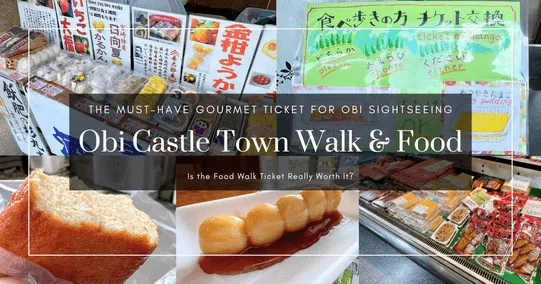
Obi Castle Town has been running a food walk initiative called “Ayumi-chan Map” since 2009. It’s a popular program that surpassed 350,000 users in January 2025.

It comes with 5 food vouchers that can be exchanged for local gourmet items like Obi-ten, atsuyaki tamago, and Obi senbei at 29 participating shops. The appeal is being able to enjoy eating bit by bit while strolling through the castle town.
The Ayumi-chan Map can be purchased at the ticket office at Obi Castle Tourist Parking or at “Nichinan-ya” at Obi Station.
Read more about Ayumi-chan Map
Culture and Experiences in Obi Castle Town
In Obi Castle Town, you can also enjoy experiences with traditional culture and seasonal events.
Obi Castle Town Festival
The Obi Castle Town Festival is the largest event in Obi, held annually on the third Saturday and Sunday of October. Started in 1978, it attracts about 47,000 visitors.
The festival’s highlights are the “Taihei Odori” dance and the “Historical Scroll Parade.” Taihei Odori is a local folk dance that began in 1707 to celebrate the reconciliation between the Obi and Satsuma domains, and is designated as an Intangible Folk Cultural Property of Miyazaki Prefecture. The dance, performed in Genroku-era attire and depicting martial arts, combines power and elegance.
On the second day, the Historical Scroll Parade features samurai generals on horseback, female warriors, and beauty queens riding in rickshaws parading through Honmachi-dori. The historical scroll unfolding against the backdrop of the historic townscape is a unique highlight of the Obi Castle Town Festival.
DENKEN WEEK
DENKEN WEEK is an art event held for about 9 days in early November each year. Started in 2018, it combines the historic townscape of the Important Preservation District for Groups of Traditional Buildings (DENKEN) with art.
Various programs are held, including art exhibitions at cultural properties, concerts, and workshops. Unique Obi experiences are also available, such as making original handmade postcards mixed with Obi cedar.
Shihanmato Archery Range
Shihanmato is a traditional half-bow passed down in the Obi Domain. It was designated as an Intangible Folk Cultural Property of Nichinan City in 1991.

The name derives from the fact that everything is “shi-han” (four-and-a-half): the distance from the shooting area to the target is 4.5 ken (about 8.2m), the length of the bow and arrow is 4.5 shaku (about 1.36m), and the size of the target is 4.5 sun (about 13.6cm). In this unique style, you sit sideways in seiza position to shoot at the target, and when you hit it, you call out “Saiko!” (Awesome!).
You can experience it year-round at the archery range next to Obi Castle Tourist Parking, and adults can casually try it for 450 yen (8 shots).
Access to Obi Castle Town
You can access Obi Castle Town by car or public transportation.
| Transportation | Nearest | Notes |
|---|---|---|
| Car | Higashi - Kyushu Expressway Nichinan - Togo IC | Obi Castle Tourist Parking (free) available |
| Train | Get off at JR Nichinan Line "Obi Station" | Bicycle rental available at Obi Station |
| Bus | Get off at Miyazaki Kotsu "Obi Castle" bus stop | Bus stop is in the same location as Obi Castle Tourist Parking |
By public transportation, you can access it from Miyazaki Station by bus or train without transfers. Both take about 70 minutes, but since neither runs frequently, it’s recommended to choose based on your itinerary.
280 Years of Heritage: Obi Castle Town with History, Culture, and Gourmet Food

Obi Castle Town features townscapes preserved and passed down as Kyushu’s first Important Preservation District for Groups of Traditional Buildings.
Samurai residences, merchant houses, and koi swimming in the waterways. The castle town landscape built by the Ito clan over 280 years continues to be preserved by residents today.
Explore historical spots, savor local cuisine, and experience traditional culture.
Experience “Kyushu’s Little Kyoto,” continuing from the Edo period, in Obi Castle Town where everything is condensed within walking distance.
